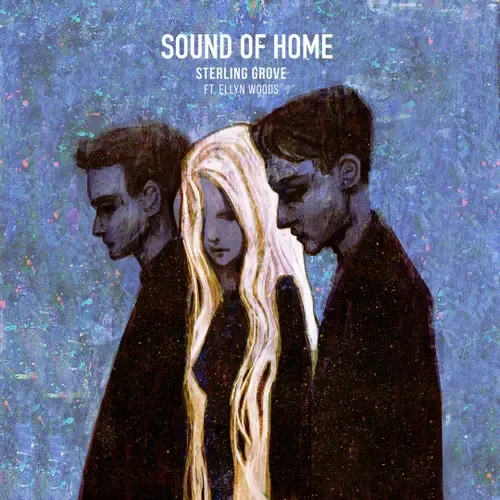
Baltra just released his great new EP In the Afterglow, and I’ve been looking forward to this after listening to his preview track Just Me & U on repeat through SoundCloud. Check it out!
small stories: I called him Love
Artwork: Nami Yokoyama, drawing from series Memories of Love and Me, 2025, charcoal and pencil on paper, old frame
I called him Love—
and I took him to the beach, where I wrote words in the sand, built a sandcastle and later, sat by a bonfire.
I took him skating, and he ran beside me.
I took him camping, and we sat in the tent with a lamp lit against the dark.
I took him flying in a plane, riding on a horse, and on my moped for long drives.
I took him with me for daily walks, past empty buildings and houses, sometimes at night where we’d sit on benches under the street lamps.
I took him to galleries to look at art, and one day I painted a picture of him.
I took him to a lake where we sat on the pier, then went out on the water in a boat.
And he sat with me while I ate, watched TV, watered the plants, looked out the window at the sky, lay on the couch, read a book, played Jenga, heated water for tea, played the piano, and did my homework.
I called him Love, and he was with me, everywhere.
© Angela Jooste
(Story inspired by Nami Yokoyama’s series of drawings Memories of Love and Me, 2025, charcoal and pencil on paper, old frames)
Colors That Survived
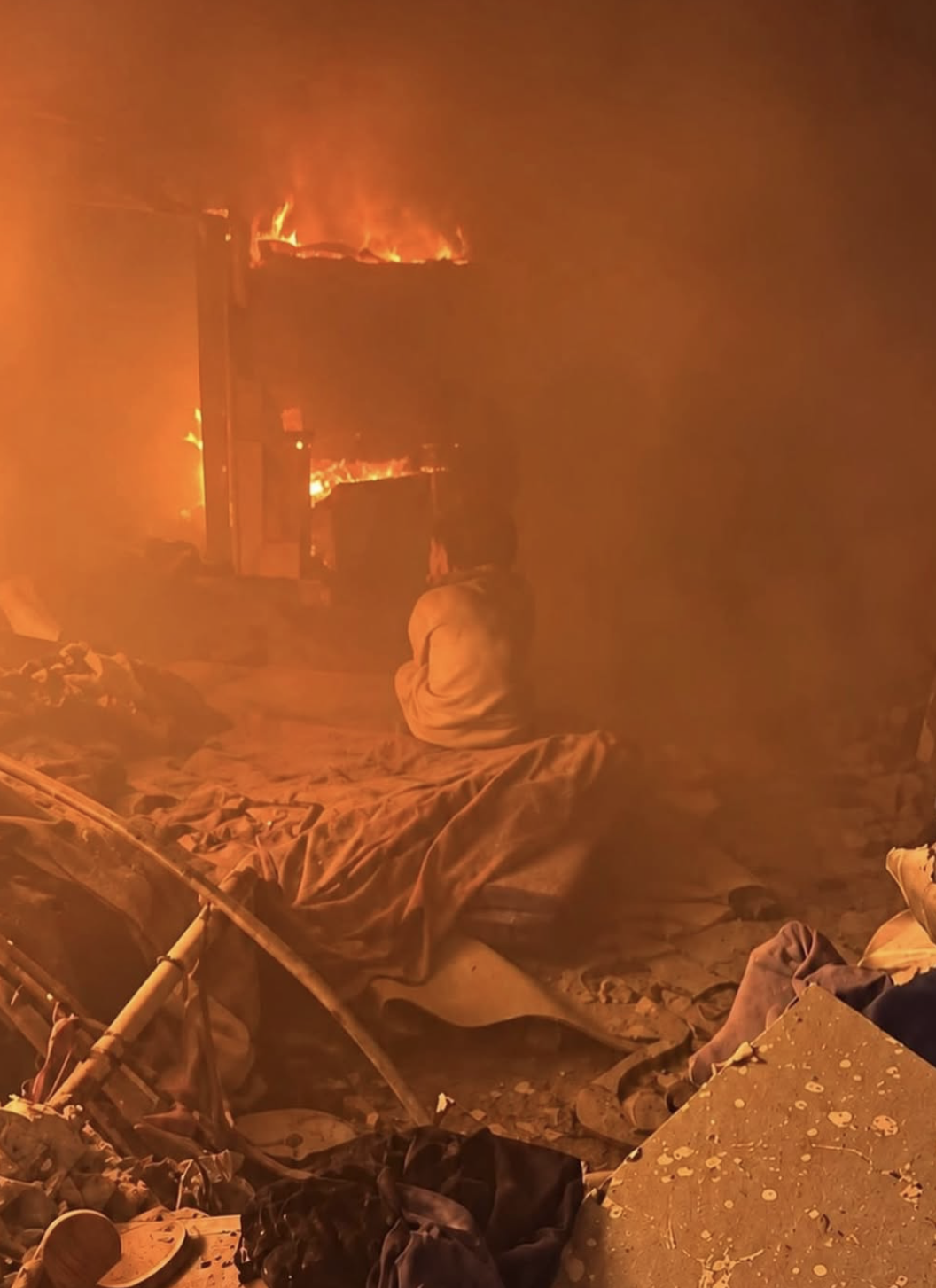
Artwork: Drawing by Ahmed Madi, 12-year-old from Gaza, 2025
An upcoming fundraising exhibition in New York, Colors That Survived, features the artwork of Palestinian children. The artworks reveal how the children experience the devastating reality of life in Gaza, and the possibility of hope for their futures. Organised by Artists Support (a non-profit that sells art to support charities artists care about, @artists_support_) in collaboration with the creators of the movie The Voice of Hind Rajab, and curated by Ms Rachel (@msrachelforlittles, an American educator who has has supported the children in Gaza throughout the genocide), the artworks featured are for sale via Artists Support from January 13-30, with the proceeds going directly to the young artists. Ms Rachel wrote this about the exhibition: “The kids of Gaza and I are having an art show in New York City! I am unbelievably proud of them! They named the show, wrote their stories, shared what this means to them, and of course created incredible art.”
A high-profile supporter of the exhibition is the internationally acclaimed artist/photographer Nan Goldin. She donated an artwork for silent auction in support of the fundraiser, Ava twirling, from her Eden and After series. Goldin is one of the few high-profile artists that has openly discussed the genocide in Gaza, because doing so comes at a cost in the western art world. Regarding her support of the Colors That Survived exhibition, Goldin said this: “I can never forget the children of Gaza and I’m grateful to be allowed the opportunity to help them in some meaningful way. The war on Gaza is a war on children wiping out multiple generations, erasing the future. According to Unicef, in the last two years more than 64,000 children have been killed or maimed. I witness the constant terror the children in Gaza live with, while supporting their families and taking on adult roles, but I also see the joy in their faces; graduating from school, singing together, and learning to love and rescue animals. The children who survive will need to be nurtured and learn to hope, after living through such unimaginable horrors.”
In November 2024, Goldin had a major retrospective at the Neue Nationalgalerie in Berlin, and courageously stood up at the opening and spoke her position regarding the war in Gaza. Goldin began by saying this: “Why did I feel I have to talk tonight? This is my lifetime retrospective, but there is nothing in it from the past year, and that’s missing. The museum has kept its promise to allow me to talk, and I thank them. But they claim that my activism and my art are separate, even though that has never been the case. The last year has been Palestine and Lebanon for me. Since October 7th, I have found it hard to breathe. I feel the catastrophe in my body, but it’s not in this show.”
Goldin’s speech and the context of the art world and its response to Gaza is excellently discussed in former Artforum editor David Velasco’s essay for the magazine Equator, “How Gaza Broke the Art World”. Velasco was fired from Artforum for authorising the publication of an open letter in Artforum on 19 October 2023, from a group of culture workers in support of Palestinian liberation and a ceasefire in Gaza. It garnered 8,000 signatures of artists and art workers, Nan Goldin included. Velasco wrote this about its impact:
“Shortly after we publish the letter, all hell breaks loose. My phone, once a conduit for benign distractions, acquires the menacing nimbus of a grenade. In the car from Newark airport, I take a call from the head publicist of Penske Media, the company that acquired Artforum a year earlier, who implores me to do something acknowledging “the other side”. Our Instagram post about the letter becomes a flashpoint, generating more than 15,000 likes in a handful of hours – far more than any other post in our history. The comments feed is flooded with emojis of Palestinian flags, but also accusations of antisemitism and calls to unsubscribe. In an unprecedented move, the publishers go above the heads of the editorial department and take down the Instagram post. They remove the letter itself from the magazine’s homepage and briefly make it invisible in the search function, so that to find it you need a direct link. Shortly afterwards, they stop responding to my messages.”
Artwork: Film still from Nan Goldin’s Gaza Notes
Velasco’s experience and those of artists, writers, academics and art workers who signed the letter is a must-read to understand the noticeable silence about Gaza the past 2 years from the western art world and academia. The article can be found here. Nan Goldin has also produced an ongoing film titled Gaza Notes that can be viewed at Equator here. Goldin wrote this about the ongoing project:
“I have no more words. This is my way of speaking out.
This piece is a work in progress that stands as a record of what has consumed me for the last two years: the need to bear witness.
This is the first genocide unfolding in real time on our phones and it is unbearable. The footage in this film is from friends who visited Palestine, the brave journalists on the ground, most of whom have been targeted, and the people living it. It remains silent because music is too directive and without sound people are forced to look more intently. The film loops because what it is showing is constantly repeating. It remains unfinished because it is not over.
It’s not the time for denial and amnesia.”
The Vampire of Goulston
Artwork by Invader, photo by @d7606, Goulston, London, UK, 2025
Love this. Cool, goth vampire in Goulston, London, by Invader (@invaderwashere).
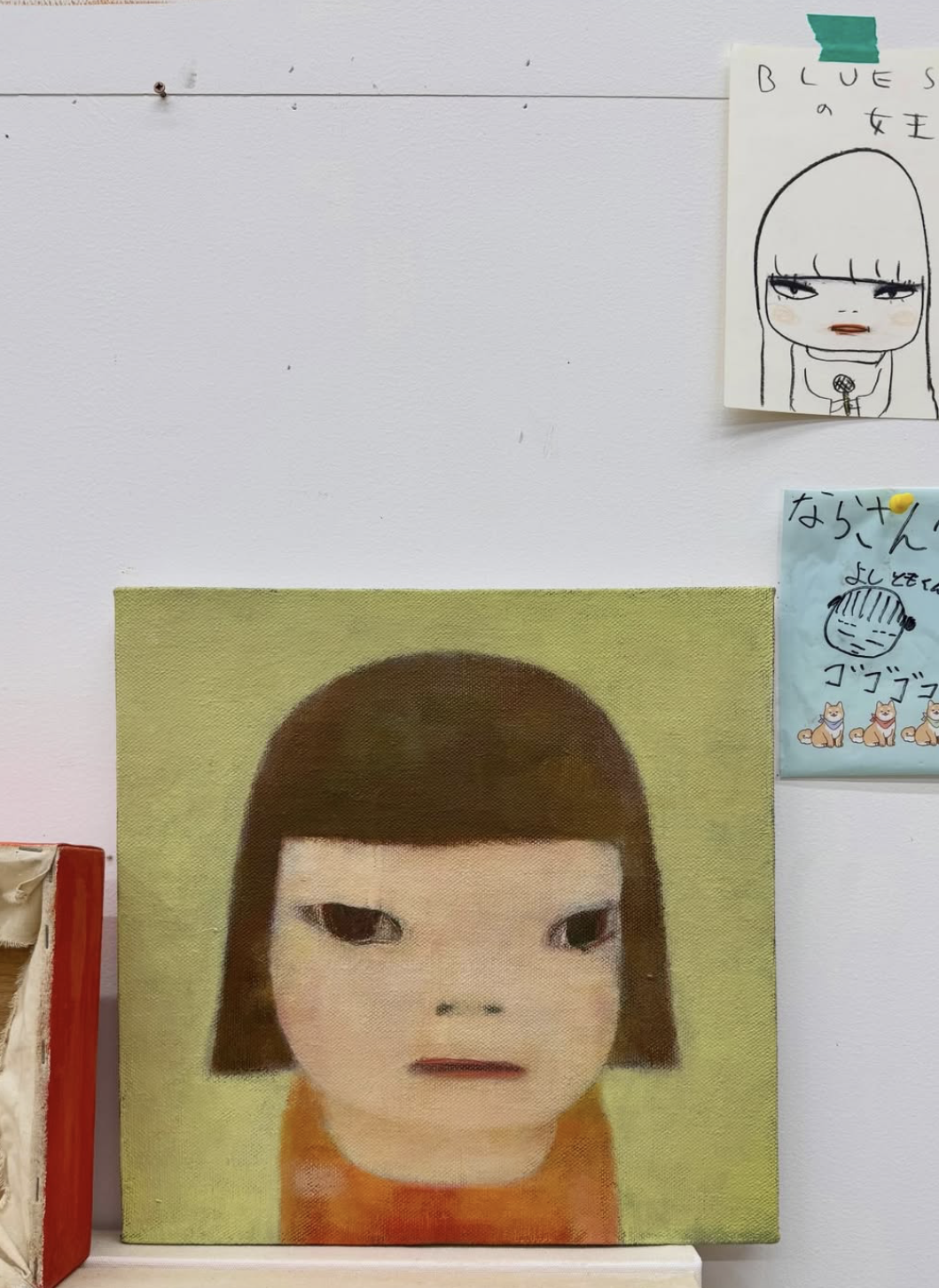
A Yoshitomo Nara Day
Artwork by Yoshitomo Nara, paint marker on paper, 2025
Freedom. Yes.
Rusty Nails
German group Moderat’s track Rusty Nails (2009) seems to be my go-to track lately. Can’t get enough of it: the vibe, the vocals, all of it. Check it out!
small stories: Stay Wild
Artwork: Print by Kenny Random, Stay Wild Moon Child, 2025
On nights he couldn’t sleep
he’d run with wolves
in the forest
on the outskirts of town.
The mask of his everyday
self, would disappear
with the moon as his guide
his skin a pelt of fur.
And he’d howl in concert
with his friends, face
arced to the sky
sounds carried on the wind.
Too soon the moon
would fade with the
light of dawn and he’d
shed fur for civility.
A slow walk from the woods
along roads, and then
houses and shops and
home, his other family.
Yet on one night
becoming morning
as he walked
he saw a girl.
Silhouetted and perched
on the roof of a house
head tilted to the fading
light of the moon.
Face obscured, she wore
a mask, so strange the boy
stopped and wondered,
how could this be?
Who was she?
A girl with a mask
like a fox, staring
at the moon
still as a statue.
And he wished
for the first time
he could reveal
his wildness.
To share the moon
and the night
to howl with another
voice like his own.
© Angela Jooste
Blue deer
Artwork: Mural by Banksy, London, 2025
Couldn’t resist! Here is a more subdued version of a Christmas deer from Banksy, tricked out with lights!
Golden deer
Artwork: Mural by DZIA, golden deer, Turnhout, Belgium, 2025
To everyone celebrating Christmas this year, I hope it’s a happy day spent with people you care about. Otherwise, happy holidays! Belgian artist DZIA recently created this eye-catching golden deer and wrote this: “A quiet animal, loud background. because subtlety is overrated in December”. 🎄
The House on Utopia Parkway
An unusual and delightful exhibition has opened in Gagosian’s Paris gallery at 9 rue Castiglione, conceived by curator Jasper Sharp and American filmmaker Wes Anderson, The House on Utopia Parkway: Joseph Cornell’s Studio Re-Created by Wes Anderson.
Cornell created his artwork, most notably his assemblage boxes, in the basement of his family’s home at Utopia Parkway. The exhibition re-creates his studio which was lined with shelves of whitewashed shoeboxes and tins filled with objects Cornell collected while visiting Manhattan bookstores, antique shops, and neighborhood dime stores. Cornell referred to this collection of prints, feathers, maps, marbles, toys, seashells, and other ephemera as his “spare parts department.”
Wes Anderson alongside exhibition designer Cécile Degos, re-created Cornell’s studio featuring more than three hundred objects and curiosities from Cornell’s own collection. Included are several of the artist’s poetic box assemblages, such as Pharmacy (1943), Untitled (Pinturicchio Boy) (c. 1950), one of the Medici series; A Dressing Room for Gille (1939), and Blériot II (c. 1956).
Installation view, The House on Utopia Parkway: Joseph Cornell’s Studio Re-Created by Wes Anderson
Artwork © 2025 The Joseph and Robert Cornell
Memorial Foundation/Licensed by VAGA at Artists Rights Society (ARS), New York. Photo: Thomas Lannes
I have always loved Cornell’s boxes and his Medici Princess (1948) inspired me to write a short story The Girl in a Box (read here) and an art story featuring Cornell’s box Toward the Blue Peninsula: for Emily Dickinson (read here). I also wrote a blog post “Box of Wonder” on the significance of Cornell’s art to American poet Charles Simic, and his wonderful book of poems Dime Store Alchemy, inspired by Cornell’s creative process, and how Simic’s own approach to writing about art inspired my Art Stories project (read here).
The House on Utopia Parkway: Joseph Cornell’s Studio Re-Created by Wes Anderson will be showing until March 14, 2026.
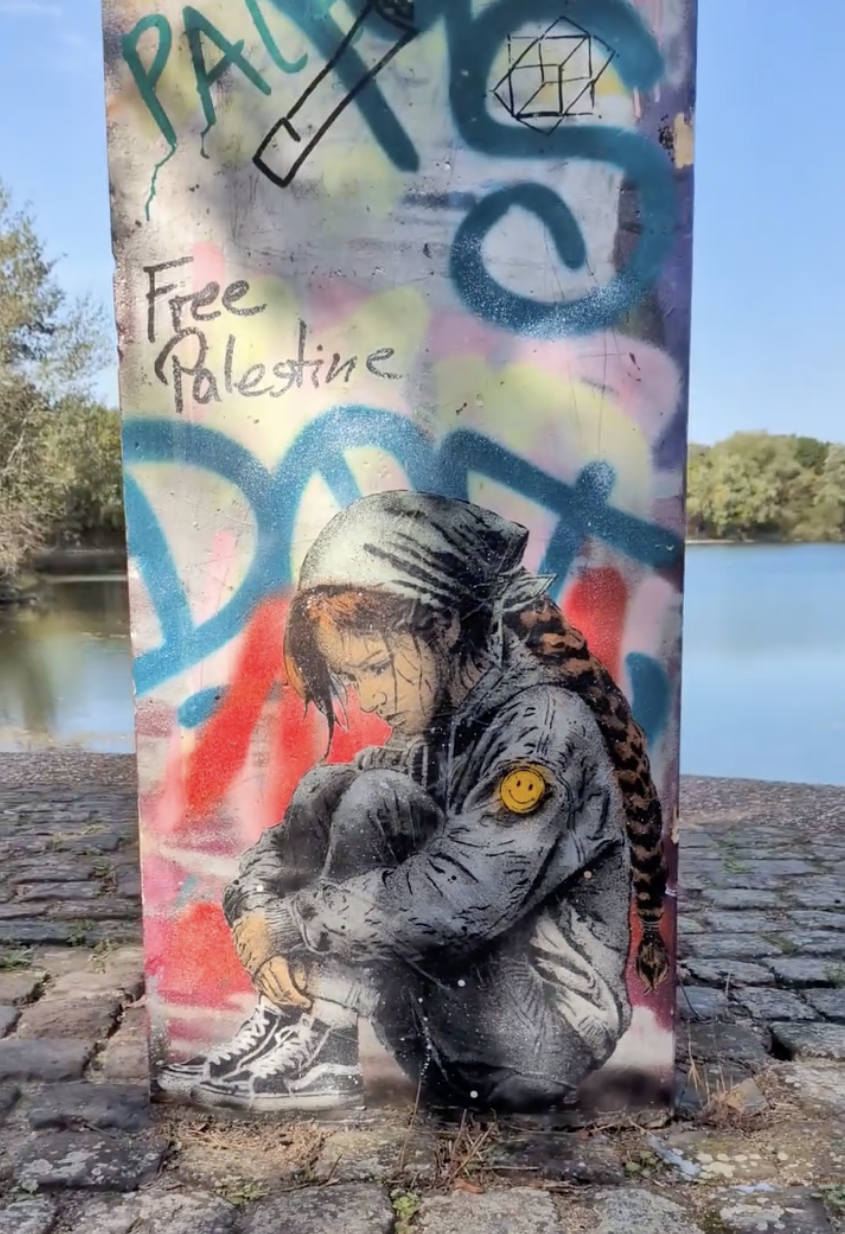
A Little Palestinian Girl
Artwork: Stencil by Cake$, A Little Palestinian Girl Blowing Barbed Wire Bubbles, Beit Jibrin refugee camp (Azza Camp) in Bethlehem, West Bank, 2025
Street artist Cake$ (@cake_stencils) created this recent stencil called A Little Palestinian Girl Blowing Barbed Wire Bubbles, painted in Beit Jibrin refugee camp (Azza Camp) in Bethlehem, West Bank. Cake$ wrote this about the piece:
”Beit Jibrin is the smallest camp in the West Bank in both size and population. It is also one of the most densely populated camps. The camp is sometimes referred to as al-Azza camp, as many of the residents are members of the Azza family. The camp has one main street, approximately 250 meters long, that runs through the entire camp. In addition to lack of services, overcrowding, insuficient water and sanitation infrastructure, the camp also suffers from frequent confrontations between youth and the Israeli Security Forces (ISF).). The camp is located in the Bethlehem municipality and is close to the main checkpoint between Bethlehem and Jerusalem.
Children of Beit Jibrin and Aida camps attend the same schools, which are the coeducational school nearby Beit Jala and the Boys’ school in Aida camp. In order to access the Aida Boys’ School, students must cross a main road close to the West Bank Barrier and an Israeli military watchtower. This area is a scene of frequent clashes, and tear gas canisters and bullets are occasionally found in the schoolyard. The school organizes activities to relieve the tension and stress caused by incursions and clashes.”
The Missing Post Office
In 2013, Japanese artist Saya Kubota created a living art installation on the small island Awashima in Japan for the Art Setouchi Triennale, and that continues to this day. The post office on the island closed because of declining population, but Kubota reopened it as an art centre titled The Missing Post Office with the purpose of housing undelivered letters that the public can visit and read. It is open for only a few hours each week, and visitors are invited to write to their future or past selves, or to anyone they wish to speak to. The letters which will not be sent into the world, are then tended to by retired postmaster, ninety-one-year-old, Nakata-san, who acts as a caretaker and guide. As Kubota noted: “In a world where connection has disconnected us, I was drawn to the simple act of writing to someone who will never answer, an act of healing on one hand, and an act of listening on the other.”
First Contact
Artwork: Mural by SATR, First Contact, Moratalaz, Madrid, Spain, 2025
Another amazing mural by London-based artist SATR in Moratalaz, Madrid, Spain titled First Contact. SATR wrote this about what inspired its creation:
"First Contact" shows a masked stray cat meeting a fox raising its paw, capturing a tentative moment in which two beings attempt to communicate by stepping into each other’s language — or what they imagine it to be.
Animals here stand for untamed emotions, while the mask suggests a second identity shaped through socialisation. To approach another often means reshaping that mask into something the other might recognise: an act that is both a reaching out and a misreading.
The surrounding grape vines extend and curl as they search for something to hold onto. They understand the world through touch rather than sight, mirroring a desire for connection that persists even without certainty or response.”
Archangel
KETTAMA’s album Archangel was released at the beginning of October this year, and the title track featuring Sølv on vocals is one I especially love and listen to a lot! It’s beautiful. Simple. Check it out!
Phoenix
Artwork: Mural by Palestinian artist in Al-Maghazi Camp, Gaza, 2025
A mural of hope and resistance. A Palestinian artist painted this powerful mural of a phoenix on the rubble of a destroyed home in Al-Maghazi Camp. Out of the devastation of the bombing and killing in Gaza, the rubble becomes a canvas for transformation out of the ashes.
The Tree in the Book
Artwork: Mural by Seth, The Tree in the Book, Ma Led Phan library, Laos, 2025
French artist Seth recently created some wonderful murals titled The Tree in the Book, in Laos at the Ma Led Phan library in collaboration with the elementary school of Nong Khiaw. Seth said this about the project: “A library is a temple of knowledge that opens windows to the world. Every book that finds its reader can inspire them, make them travel and develop their imagination.” I absolutely agree!
small stories: Journey to the End of the Night
Artwork: Painting by NEAN, Journey to the End of the Night, acrylic on canvas, 2025
and I walked
into the sky
so low to the
ground
into night
as the day
collapsed
and the stars
ignite
just a shadow
marked
myself upon
this earth
and the clouds
heavy above
enough
to carry me
home
© Angela Jooste
A Yoshitomo Nara Day
Got a lot on my mind…
Shattering and Gathering Our Traces
Artwork: Kader Attia, Resonance, mixed media, 2025
Algerian-French artist Kader Attia’s recent exhibition at Lehmann Maupin in New York, Shattering and Gathering Our Traces, is a poetic meditation on the concept of repair and renewal. Where wounds—whether historical, public or individual—are addressed, highlighted and mended through the material process of artmaking, and that reflects a broader dialogue with what it means to be human. Attia believes a core aspect of his work is as a researcher, and his artwork melds ideas with the material, delving into areas such as history, migration, colonialism, identity and culture. On the specific theme of the exhibition, Attia says, “The idea is that traces aren’t necessarily already broken, but by their very fragility…they always carry the potential to be shattered at any time. This tension between breaking and mending runs through everything I do.”
Everyday objects, artefacts and war-time memorabilia become the basis for his installations invoking memories, stories, and intuitive associations. Of his practice, Attia says, “There’s always been poetry in my work, a way of lifting the narrative toward something more hopeful, more human. When you’re too politically precise, you risk losing that broader connection. Poetry, instead, can carry emotion and meaning to places that facts alone can’t reach.”
One of the central installations of the exhibition is Resonance (2025). Initially titled, Social Media, in this work Attia explores the idea of the illusory nature of experience and interaction through technology and social media. Regarding technology Attia says, “I’m not against technology. I use it, but I wanted to respond to it with low-tech artwork. To bring back the physicality of experience, the playfulness that art can offer, even when it carries a serious message.” The tension in the artwork between connection and isolation is explored by filling the main gallery space with birdcages, each suspended by slender ropes and containing a small bell. Beneath each cage hangs a thicker rope extending to the floor. Visitors moving through the space brush up against or pull the ropes, resulting in the bells chiming softly and irregularly.
Speaking about the installation, Attia says, “For a long time, I was very focused on the political critique of what we call the ‘information society’. We live in a time where everyone speaks constantly—posting, commenting, sharing—but very few people actually listen. On social media, we believe we’re addressing the world, yet we’re really talking to a handful of people. It’s a society of endless communication that ends up as miscommunication.” Each birdcage is a metaphor for an individual voice, and the overlapping sounds of bells forms a collective and transitory coexistence within a broader network. For Attia each bell, each human voice is “…a sign, a signal, trying to be heard.”
Shattering and Gathering Our Traces is showing until December 13, 2025.
you're a star
Fred again.. and Amyl and the Sniffer’s track you’re a star, is one of those songs I can’t stop listening to, even a month out from the release. Big bass and gritty sound perfectly matched with lyrics and voice makes for a great vibe. Check it out!