Walking down Swanston Street to meet a friend and yo!—some yarn bombers had got warm and fuzzy with the trees...

Walking down Swanston Street to meet a friend and yo!—some yarn bombers had got warm and fuzzy with the trees...

Well, there was a delay due to techie issues in getting the Amazon release of Chasing Light—but finally—it's out there!
Many, many thanks to the very talented designer Vicky Tu of Two Feathers (vicky@twofeathers.com.au) for the cover—it was great working with her to make it happen.
So—if you're interested in contemporary stories about relationships, family, friendship, love, loss, figuring stuff out, surfing, street art, art...this might be the book for you!
Check out the Chasing Light page on this website for an extended blurb etc. It is a Young Adult book and only available as an ebook from the following outlets:
Enjoy!!
And feel free to post a review and share it with someone who might also like this story.
Do what you love.
Easier to say than do! Finding something you're passionate about and then making the effort to do it takes guts, determination and hard work.
If you've ever wondered what you might love to do and how to go about doing it, check out this great article by Paul Graham, How to do what you love (web article). Here's an excerpt:
"To do something well you have to like it. That idea is not exactly novel. We've got it down to four words: ‘Do what you love.’ But it's not enough just to tell people that. Doing what you love is complicated."
For some, the commitment to follow their passion comes with its own problems. Perhaps what you love doing morphs into work—a job—and the everyday stuff that a job entails, such as business dealings, deadlines, money commitments and the pressure to keep a certain standard. Losing that spark that fires you to keep making work is a real possibility.
And then there's success. Yes, this can be an issue! Writer Elizabeth Gilbert talks humorously about how the success of her Eat, Pray, Love became a challenge to doing further work, and led her on a journey to find her muse. Check out her TED talk on “creative genius” here.
The flip side of success is failure. For J. K. Rowling, failure became the motivator to follow her love of writing and to create Harry Potter. In her wonderful commencement speech to Harvard graduates (and yes, there is a whiff of irony here, discussing failure to graduates from one of the most elite universities in the US!), she speaks of personal failures, life experience and how hitting a low point all became fuel to pursue her passion.
Do what you love.
It might not be straightforward or easy, but you'll never know where the ride will take you until you try.

Image: Ariadne in the film, Inception
Okay. Time to get lost.
My friend Han returned my copy of the film Inception some time ago, and she’d stuck a yellow sticky note on it with a thought bubble: “I still don’t get this???”
Aside from laughing at the comment, it got me thinking so I watched it again, and whoa—it’s a trippy film, but what struck me was, at it’s heart it says a lot about storytelling.
And that storytelling is a lot like constructing, journeying and getting lost in a labyrinth.
A couple of other incidents lined up to make this observation seem even more plausible. I was at lunch with a friend and she’d read a manuscript of mine and made the comment that she’d got sucked into the story and it was similar to getting lost in a labyrinth.
As for number three (and perhaps there are no coincidences here...), I found this gorgeous exhibition catalogue on contemporary tapestry and weaving The Fabric of Myth at Compton Verney in Warwickshire, United Kingdom (2008). In the catalogue essay Ariadne is interpreted as a storyteller:

Image: Ariadne, 5th century AD, woollen tapestry from Egypt
“In cloth-making or storytelling, one begins with a thread. One thread, one thought. The legendary figure of the storyteller begins with Ariadne, the jilted lover of Theseus who went on to marry the god Dionysus […] Ariadne’s thread represents a story’s narrative, for it is the storyteller who creates a labyrinth of thought, leading her listener into another world…”
I love the myth of Ariadne and the labyrinth, so all these connections set my mind spinning. Christopher Nolan (director of Inception) has the character Ariadne as the builder of the dream/labyrinths (in the ancient myth it’s Daedelus), but also the one who leads Cobb down into his deepest subconscious, to face his demons. In the myth, Ariadne offered Theseus the thread to help him find his way into and out of the labyrinth, but ultimately, to face the Minotaur. There are wonderful parallels here.
The Swiss psychoanalyst, Carl Jung, likened the journey of individuation of having to go deep within oneself to unravel one’s own psyche (soul) in order to transform, to become more conscious, as being akin to journeying into a labyrinth. Leonardo da Vinci constructed a model labyrinth, where at the centre, was a hexagonal room made of mirrors. At the centre, you have to confront yourself.
Similarly, to free himself in Inception, Cobb must go down (effectively into limbo, and again, Jung refers to the labyrinth as a symbol for the underworld), to face his wife/conscience (sorry— spoiler!) to accept his part in her death in order to transform and incorporate this experience consciously.
There are so many layers in this film, just like a great story.
But a narrative constructed as a labyrinth—the noun text comes from the Latin texere which means “to weave”. Ariadne had her thread, her clew, to weave through the paths of the labyrinth; to give a sense of connection and direction. In walking, or weaving through the labyrinth, we continually recreate the journey, so that we become co-creators of the labyrinth.
So, there’s all these elements: of text as weaving; of the writer as creating threads/clues for the reader to follow—to get lost in the story, its layers, complexity, another world, its wonder—but to provide a means for the reader to navigate and come through to the end of the story.
And maybe the reader will be transformed. Maybe they’ll have a new perspective or idea about something. Maybe they’ll feel different themselves, or about those around them. Or, maybe simply, they’ll have been entertained for a time, enjoying the escape from their own lives.
But the writer/storyteller as the creator of labyrinths—it’s a beautiful idea.

It's crazy with people Christmas shopping in the city—but this fantastic reference to Miyazaki's character 'No Face' in the film Spirited Away caught my eye...(perfect placement near the dumpsters!).

Image: Poem by Jason Fotso, 2014
This went straight to the heart.
Poet Jason Fotso's words when he posted this on Twitter: "A poem I wrote about Eric Garner, written solely with rearranged letters from the entirety of his last words."
Eric Garner, rest in peace.

Yeah—another one of those days...
Neil Gaiman Addresses the University of the Arts Class of 2012.
Sometimes I need a little inspiration. Neil Gaiman's commencement speech titled “Make Good Art” hit the nail on the head. It's funny, pragmatic, wise and based on first-hand experience. And it's about keeping it real, and keeping focused on what being creative is about (no matter what your field is)—making good art.
Edges of Sanity - A film by http://www.finisterreuk.com Director: Chris McClean Producer: Ernest Capbert
CWS—cold water surfing.
That’s what the UK company Finisterre (website) is passionate about. So much so, they made a short film about it.
And while the footage alone has an eerie beauty, it’s the poem by Daniel Crockett, Edges of Sanity, narrated by Game of Thrones actor, Charles Dance, that takes this short film beyond mere surfing footage to something quite special.

He was blind, living isolated on a small block of land, on the outskirts of a town in the country. And every Sunday—he’d dress for church. A worn, patched suit, dark grey, with a hat.
As he reached the front door, he grasped for a wire that led from the house to the main gate, and the road. He’d hold onto a pole, hooked onto the wire, slowly walking to the place where he’d be picked up to go into town.
Once a week.
© Angela Jooste
Black Rebel Motorcycle Club, 'Let the Day Begin'
Here’s to a better day…
And here's BRMC's cover version of The Call's Let the Day Begin from their album Specter at the Feast (2013)—a great song and a great video. Yeah—I've been listening to these guys a lot lately...they're brilliant (check out their music and website: http://blackrebelmotorcycleclub.com)
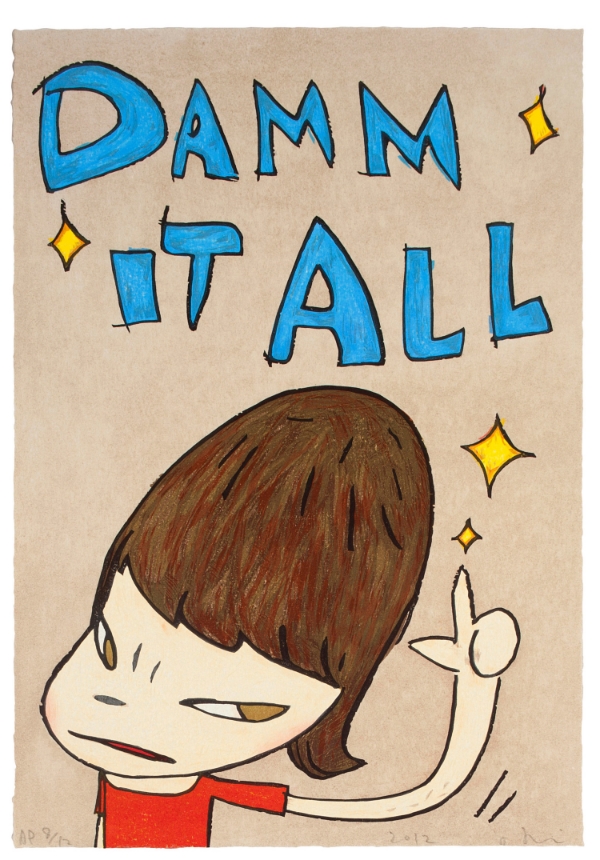
It's been one of those days—stumbling through computer techie problems, wading through one admin issue after another...BLAH! So, thanks Yoshitomo Nara, I couldn't have expressed this better myself...
I'm a fan of BRMC, but this is something unusual—this is their take on Edgar Allan Poe's beautiful, haunting poem Annabel Lee. It captures the feel perfectly. Check out this live version. Also, you can find the recording on their album, Beat The Devil's Tattoo (2010).

I was really fortunate to get to see a pro surf comp at Pipeline in Hawaii, and while I'm not big on crowds at the beach, it was amazing to see pro surfers at this particular break. What was also incredible was the sheer energy of the wave, which I could feel from where I was sitting on the sand.
I love swimming in the ocean and I'm not a surfer, but I love surf watching. Surfing is a great metaphor for life, and generally for feeling alive. Setting my novel Chasing Light at a fictitious beach was a great way to get one of my characters to surf!
Here’s a quote from one of the ‘masters’ of Pipe, Gerry Lopez, from his book, Surf is Where You Find It (2008) that I love and sums up his approach to surfing:
“Surfing is whatever one wants to make it. With the fluid stage and the cast of characters, anything goes is usually the rule...actually there aren't any rules. This is what makes surfing so appealing, But in my almost 50 years of surfing, I've made a few rules for myself [...]The fifth and final Lopez rule: The best surfer in the water is the guy having the most fun. I try to remember that one.”

Meg Rosoff is a wonderful writer. When I first read How I Live Now, I was utterly captivated by the voice of 15 year-old Daisy, and her story about surviving war; finding family; leaving home only to discover what home really is; falling madly in love and ultimately, figuring out what she truly valued. It was hilarious, heartbreaking, magical and oddly hopeful. I've read everything she's written since.
I've also been an avid reader of what she has to say about writing. Here's a list from her blog post (check out the full post here), where she equates learning to write to being a medieval apprentice shoemaker—it's incisive, funny and great advice.
How to Write
by Meg Rosoff
[...] And so here are a few things I learned in my apprenticeship.
READ. Bestsellers and obscure new writers, 18th, 19th and 20thcentury writers as well. Shakespeare. History and fiction, memoir and picture books, everything that’s really good and occasionally some stuff that’s really bad. Ideas come from everywhere, and besides, if you’re not interested in books you shouldn’t be writing them.
Marketing is important. If there’s no market, there’s no money (and writing is, after all, a job – a better than average job, but a job nonetheless).
But….ignore the market when you work. People writing solely to make money can always be picked out of a criminal line-up. They look cheap, sweaty and desperate. The rest of us just look desperate.
Know how to write. Really, it helps.
Spend time thinking. Writing’s only about 20% of the job. Sometimes less.
There are no rules. Your job is to break the rules.
Be wise. Know more than your audience about something — anything.
Cut to the chase. The average attention span of the modern human is about half as long as whatever you’re trying to tell him (or her).
Get a life. Breadth of knowledge is good, emotional depth is even better.
Lie about everything except passion. Chairs can talk. Pigs can fly. But if you don’t care about what you’re saying, no one else will either.
Listen to what other people have to say. If fifteen people say that your shoe is dull, heavy and cloddish, it probably is.
But…when a publisher says ‘that sort of book doesn’t sell,’ don’t throw it away. No one knows what sells. Until it does.
Don’t worry about your connections (or lack thereof). Anyone who’s really good will get there. Blind, dogged persistence passes the time between now and then.
Edit ruthlessly. Do not fall in love with your own prose. God invented the delete button to help you.
Keep at it. It’s a long game (ask Mary Berry about her 30 years in the wilderness). No one has an easy run from beginning to end.And that goes for life as well as writing.

Artwork: Paste-up by OBEY
Wandering around the city, Friday afternoon Halloween! Happened to look up to find this great paste-up by street artist OBEY (Shepard Fairey).

Artwork: lonely_girl by_splinter_ops
There she goes again.
The paper cut-out girl.
She’s wearing the same woolly coconut ice striped beanie, complete with panda ears. It’s something a kid would wear. Except, she’s not a kid anymore. Although, I wonder if that’s what she wants to be—an eternal child—never having to grow up.
She’s buttoned up tight in her wool check jacket, layered with a jumper and shirt so you can’t see her outline; the way her bones are jutting out. A body too thin to carry the weight of so much wool.
I saw her most days. I’m not sure if she’s going to school or work. Her thin legs are clad in tights and her feet—I can’t keep my eyes off the high top pink Converses. She wears them no matter the weather.
I think she wants to hide, but the hat and the sneakers make her conspicuous. Maybe it’s a way to only get people to notice parts of her, not the whole, because then they’d have to see how sometimes she walks slowly, carefully, and that each step seems painful.
She often carries a red and white backpack, and I can't help stewing over how she manages the weight when she wants to shed so much of her own.
Once I tried drawing her, but the lines were too faint, too scant as if I couldn’t pin her to the page. So I cut out a space in the paper where the girl should have been.
She was present in the world by the very space she was absent from it.
© Angela Jooste
“Art is truth because it is eternal.”
Louise Bourgeois (1911-2010)
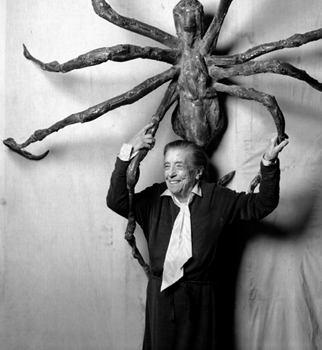
The first time I saw Louise Bourgeois's work at an exhibition, I discovered something that altered my relationship to art profoundly. I remember being mesmerised by her sculpture Spiral Woman, and walking away wanting to write about it, but not with the language of theory or criticism, but with poetry. That stumped me. I was an art history student, used to navigating the discourses that shaped current art historical practice—of writing texts with cross-disciplinary theory, historical methodology, visual analysis—dry, distant and "learned" writing that spoke to academics. But no, I wanted to write a poem, and I did. That was the beginning of my Art Stories project. I later discovered that my impulse to write about art creatively had a tradition after reading art historian Paul Barolsky’s interpretation of Giorgio Vasari's Lives of the Artists (first published in 1550), one of the foundation texts and primary source material in studying the Renaissance, as being a work of fiction. That was mind-blowing to me. And while I'll save talking about that tradition for another day, it affirmed what I was doing, and that I wasn't alone.
When I came to write about Louise Bourgeois's work Cell (Glass spheres and hands), I delved into some of the recurring themes of her work: the pain of deception and betrayal; the blurred lines of truth and lies; the cut of rejection; how risk is inherent in love and that safety in relationships is a precarious concept. And fear: of being alone, denied, unloved. What is exceptional and challenging about Bourgeois's work for me, is its mystery and how its secrets are not yielded easily, if at all. Her work evades categorisation and simple theoretical or biographical approaches. Her own words might point to a meaning, but she herself once said: “I never talk literally. Never, never, never. You do not get anywhere by being literal, except to be puny. You have to use analogy and interpretation and leaps of all kinds.”
By being so elusive, the openness of Bourgeois's work to interpretation is enduring. And her ability to elicit such an emotional and imaginative response, it makes her art eternal.
I've been thinking of writing a story about Swiss artist Pipilotti Rist's installation I saw a couple of years ago at ACCA, I Packed the Postcard in my Suitcase, and I remembered a lecturer at uni mentioned this small, brilliant and hilarious video of her trapped under the floor at PS1—in hell. It's called Selbstlos I'm Lavabad and Rist is swimming in a lava bath crying out, “I am a worm and you are a flower!” This video was first exhibited in Basel, Switzerland in 1994.

I love this artwork of the rhino with a city on its back by Mike Maka aka MAKATRON (check out his website: http://www.makatron.com) . I first saw a similar version of this while Maka was actually creating it at an intersection on Lygon St near the Melbourne Cemetery. It also became a fave of the character Jake in my book Chasing Light (forthcoming late 2014).