Image: Yoshitomo Nara Peace flag
Love Peace
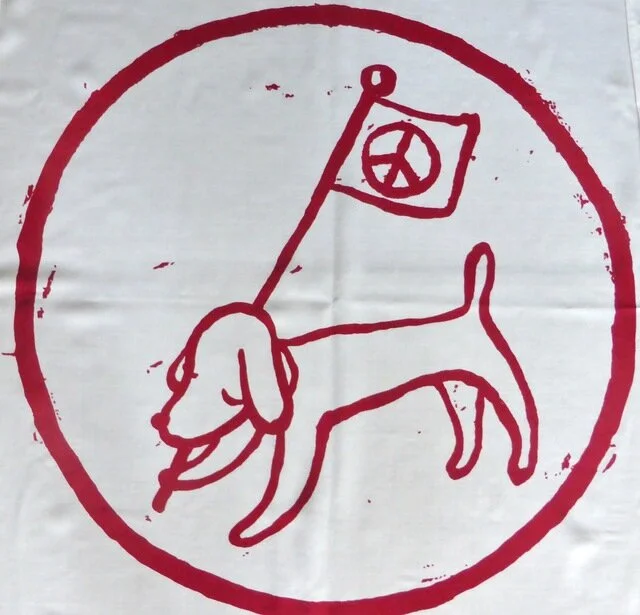
Image: Yoshitomo Nara Peace flag
Love Peace

Image: @hurley
A poem to reflect on as the year ends. Ursula Le Guin’s Infinitive:
We make too much history.
With or without us
there will be the silence
and the rocks and the far shining.
But what we need to be
is, oh, the small talk of swallows
in the evening over
dull water under willows.
To be we need to know the river
holds the salmon and the ocean
holds the whales as lightly
as the body holds the soul
in the present tense, in the present
tense.
(from Ursula Le Guin’s collection of poems, Sixty Odd, 1999)

Artwork: Millo, Wish 2019, Lecce, Italy (@_millo_)
Street artist Millo’s new mural Wish in Lecce, Italy, speaks about the beauty of connection, and the importance of working together as community. The mural is located in a multi-cultural and multi-ethnic social housing neighbourhood located where one of the biggest court cases against the Mafia was held in the 1990s.
What I love is the red thread twining the two people together and its symbolism. I’ve written before on the the use of red thread particularly in Asian art, where it has potent meaning. For instance there is the Chinese folk legend, “The Red Thread of Fate”. It tells of how when children are born, invisible red threads connect them to their soul mates. Over the years, their lives become closer until they eventually find each other, overcoming social and physical divides that might otherwise separate them. This magical cord might stretch and tangle, but will never break.
In the spirit of the holidays, Millo’s mural has special resonance as hopefully a time of love, connection, empathy and peace. And despite whatever trials and uncertainty we face, of wishing the best for each other and for the coming year.

Artwork: Paste-up by DONK, 2013
B. brave
Paste-up by street artist DONK (@donklondon), 2013.
Whatever you’re doing. Wherever you’re at in life.
In DONK’s words: “A gentle reminder that we all need to be brave at times, and that human vulnerability is in fact a human strength.”
B. brave

Too cute, he is. Baby Yoda from the new Star Wars offshoot series The Mandalorian. Love the pairing of the helmeted/masked warrior with the gifted child. And this little guy is over-the-top adorable!

Artwork: Adrian Villar Rojas, Poems for Earthlings, Oude Kerk, Amsterdam, 2019
What will remain after the end of humanity, the end of art? What would be the last piece of art made by a human before we disappear from earth?
These deeply unsettling questions are at the heart of Argentinian artist Adrian Villar Rojas’s work.
Rojas’s art blurs fact with fiction, delving into ideas of multiple-universes, alternative evolutionary narratives, alien perspectives, the Anthropocene, and the interrogation of art as commodity, of its questionable endurance into perpetuity through its preservation in art museums. His installations are site-specific and transient, many of the objects destined to be destroyed or to disintegrate. His practice leaves little trace of his projects around the globe, yet each installation is linked by the overarching question of art and its relevance in a civilsation that could end.

Artwork: Adrian Villar Rojas, The Murderer of Your Heritage, Arsenale, Venice, 2011
His most recent site-specific project at the Oude Kerk (Old Church)—recognised as the oldest building and parish church in Amsterdam, located in the Wallen, or Red Light District—titled Poems for Earthlings builds on these ideas and two previous projects from 2011.
Rojas’s installation at the Venice Biennale in 2011 was titled, The Murderer of Your Heritage. Constructed at the Artigliere in the Arsenale, huge sculptures made of clay over a framework of cement, burlap and wood, dwarfed the viewer in a tight and dramatically lit arrangement. These strange hybrid creatures, part machine, plant and fictional, were either from some other planet, or maybe they’re the future inhabitants of Earth. This colossal endeavour was taken further in a site-specific sculpture in the Jardin des Tuileries, Paris. Also titled Poems for Earthlings, the telescopic column seemed at once recognisable and otherworldly, a ruin perhaps of a future civilisation. An alien civilisation? This time-travel, time-looped sculpture was eventually destroyed after its one-month showing.

Artwork: Adrian Villar Rojas, Poems for Earthlings, Jardin des Tuileries, Paris, 2011
The sandbagged and heaped mounds at the Oude Kerk imply a bulwark against threat; a construction of primitive temples or burial sites; of temporary refuge and again, as in so many other works, the futility of preserving our human built environments and artworks indefinitely against the natural incursions of a world in crisis.
Something short and beautiful.
A glimpse at choreographer Antonin Rioche’s dance for the Nederlands Dans Theater’s performance Here we live and now currently at the Korzo Theatre in the Hague. It’s titled Finally a sign of life.

Artwork: Kristen Mosher Soul Mate 180° (The Other Side is Here), LACMA, 2019
Kristen Mosher’s art project Soul Mate 180° (The Other Side is Here) is an ongoing venture, or adventure.
At the core of the project is the merging of two concepts. The first is the notion of a “geographic soul mate” defined as “an intimacy created by acknowledging distances” and “a relationship with the other side of earth not as a polarity or opposite but as a fluid, shifting continuum that extends within and beyond the planet”. The second is the antipodes—the opposite of where you find yourself. The word “antipodes” originates from the Latin idea of “feet against our feet”, of inhabitants on the other side of the globe. These foundational concepts shape Mosher’s project that seeks to explore points on the earth separated by 180°.
At the current iteration of her project showing at the Los Angeles County Museum of Art, Mosher has created a sculptural rendering, sourced via satellite imagery and utilising 3D printing, of a specific segment of the waves of the Indian Ocean identified as the antipode of LACMA.
Mosher states: “The strength of Soul Mate 180° rests in the tension between what can be seen and what is imagined.”
Just imagine: your feet where they stand right now, and what’s on the other side of the globe.
Reaching the antipodes is a tumbling down the rabbit hole with its upside down logic that’s about being able to wonder what’s on the other side than truly knowing or experiencing it first-hand. Yet Mosher’s project facilitates such an imagining, a simulated reality, simply by offering a glimpse—this tunnelling to view a wave on a vast sea.
(source: www.kristenmosher.com)

Image: Kagami Smile album, Pool of Light (2019)
Thought I’d share this beautiful and electrifying track by Kagami Smile, Suspended Bliss (When I Last Hear Your Voice) from his album Pool of Light (Dream Catalogue, 2019). I discovered him through listening to the artist Object Blue, who is pretty wonderful as well. If you’re into electronica, glitch, techno, ambient, downtempo—whatever!—check this out. Feels like listening to the future.

Boo…

image: @werenotreallystrangers
Just perfect. This sums up my day…and freaking FedEx had something to do with it!

Artwork: L.E.T. (@l.e.t._les.enfants.terrible)
Another fave from artist L.E.T. (@l.e.t._les.enfants.terrible)—“Your Weird Is My Perfect”.
Truth.

Image: @orion_deepspace; Source: @universetoday
Reading this particular stanza just choked me up (in a good way!), from W.H. Auden’s love poem to the stars and the universe, The More Loving One:
“How should we like it were the stars
to burn
With a passion for us we could
not return?
If equal affection cannot be,
Let the more loving one be me.”
(source: www.brainpickings.org)

Artwork: WRDSMTH, LA 2019
Awesome recent paste-up by WRDSMTH in Los Angeles.

It’s spring and the gorgeous scents of orange blossom and pittosporum, especially at night, inspired me to post this—a vivid, alchemical site-specific installation titled Falling Garden, created by Swiss artists Gerda Steiner and Jörg Lenzlinger for the 2003 Venice Biennale at the 17th century San Staë church on the Grand Canal.
The suspended garden—including vegetation from around the world—was inspired by the possibility of mystical and miraculous experiences. Depicted in San Staë’s alter painting is the story of the miracle of the church’s patron saint, San Eustachio. During a hunt, the Imperial huntsman and army commander is converted to Christianity following an encounter with a stag bearing the crucified Christ, its antlers surrounded by a luminous halo.

The idea of the site being a place to experience such wonders was a touchstone for the artists transforming the space with a rain of vegetation and crystallized flowerbeds, as if it were the wilderness where the deer was encountered.
A place where the extraordinary could occur.

Artwork: @buber_nebz
This kind of sums up a story I recently posted, The thought of you is everywhere (it’s a long read!). It’s a love story, but it’s also a love story about music.
teamLab, 2019, Interactive Digital Installation, Sound: Hideaki Takahashi
There’s an expansiveness, freedom and openness to change in teamLab’s digital installations.
In their words: “teamLab believes that the digital domain can expand the capacities of art, and that digital art can create new relationships between people.” (teamLab website)
This year, a major teamLab immersive digital installation was featured at the opening of the Tank Shanghai art complex, titled Universe of Water Particles (2019); a cascading waterfall that responded to people’s “touch”. When an individual “touched” the streaming water it then flowed as if meeting a rock in a stream, which in turn caused flowers to scatter in the corresponding artwork Flowers and People, Cannot be Controlled but Live. It’s an artwork alive to the beauty of nature and its connection to humans, with a surreal edge in the use of digital technology to simulate this heightened awareness.
Using digital technology teamLab explore pre-modern Japanese notions of space, where 3-D reality was depicted as a flat/2D spatial awareness. TeamLab flip this perspective so that digital projections on flat surfaces become 3D spatial experiences. They term this spatial structuring as “ultrasubjective space”, resulting in immersive and transformative environments, where individuals engage with the work from their unique point of view. It’s also an interactive space where the individual’s very movements/behaviour can alter the artwork, becoming co-creators in its continuous unfolding. This blurring of the boundaries between the individual and the artwork is also enabled by “splitting, folding and dividing” the images/screens, creating a space of connection and fluidity, of mutability, where the artwork doesn’t feel bound by physical space and also, a sense of play and wonder.

Image: Portico Quartet’s album, Memory Streams, 2019
Been listening to Portico Quartet’s new album Memory Streams, and this gorgeous track is a fave—feels kind of like flying—Ways of Seeing. Check it out.

Artwork: Kelly Akashi’s Be Me (Cultivator), 2019, cast stainless steel and flame worked borosilicate glass
A new artwork from American artist Kelly Akashi to be featured at FIAC Contemporary Art Fair in Paris this year at François Ghebaly Gallery’s booth, Be Me (Cultivator), 2019. Love her work (see my two art stories Feel Me and Ripple).
Simply exquisite.
