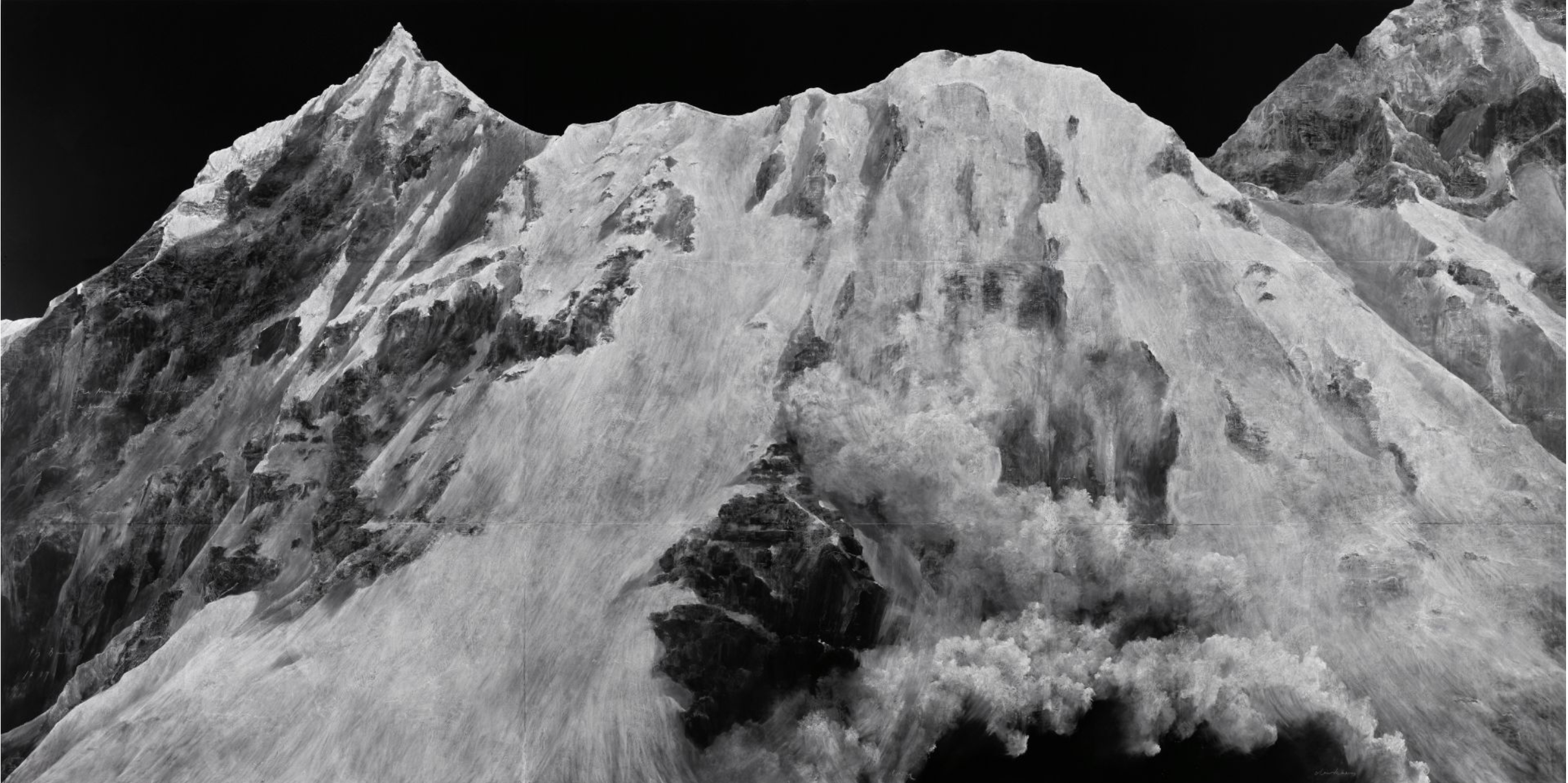
Artwork: Tacita Dean, The Montafon Letter, 2017, chalk on blackboard
Last year British artist Tacita Dean had her first major United States museum survey exhibition, Tacita Dean: Blind Folly at the Menil Collection in Houston, Texas. It travelled this year to the Columbus Museum of Art in Ohio, and ended its showing on March 8. The focus of the exhibition was Dean’s chance-based drawing processes across various mediums, including film and photography, as well as spanning monumental blackboard drawings to intimate sketches on found postcards.
The title Blind Folly has its source in Dean’s artmaking process and philosophy, encapsulated in her words: “For years as an artist, I allowed the making of my work to be open to interpretation and redirection by chance, and what I describe as contingency: events occurring through the practical necessity that become instructive or defining in retrospect. Working like this, just beneath my conscious level, requires an aspect of willful blindness. It is uncomfortable at best and terrifying at its worst and necessitates a private belief system—faith that something will inevitably rise to the surface not unlike the unearthly subterranean vapors summoned to human intelligibility by the priestess Pythia, the Oracle at the Temple of Apollo at Delphi.”
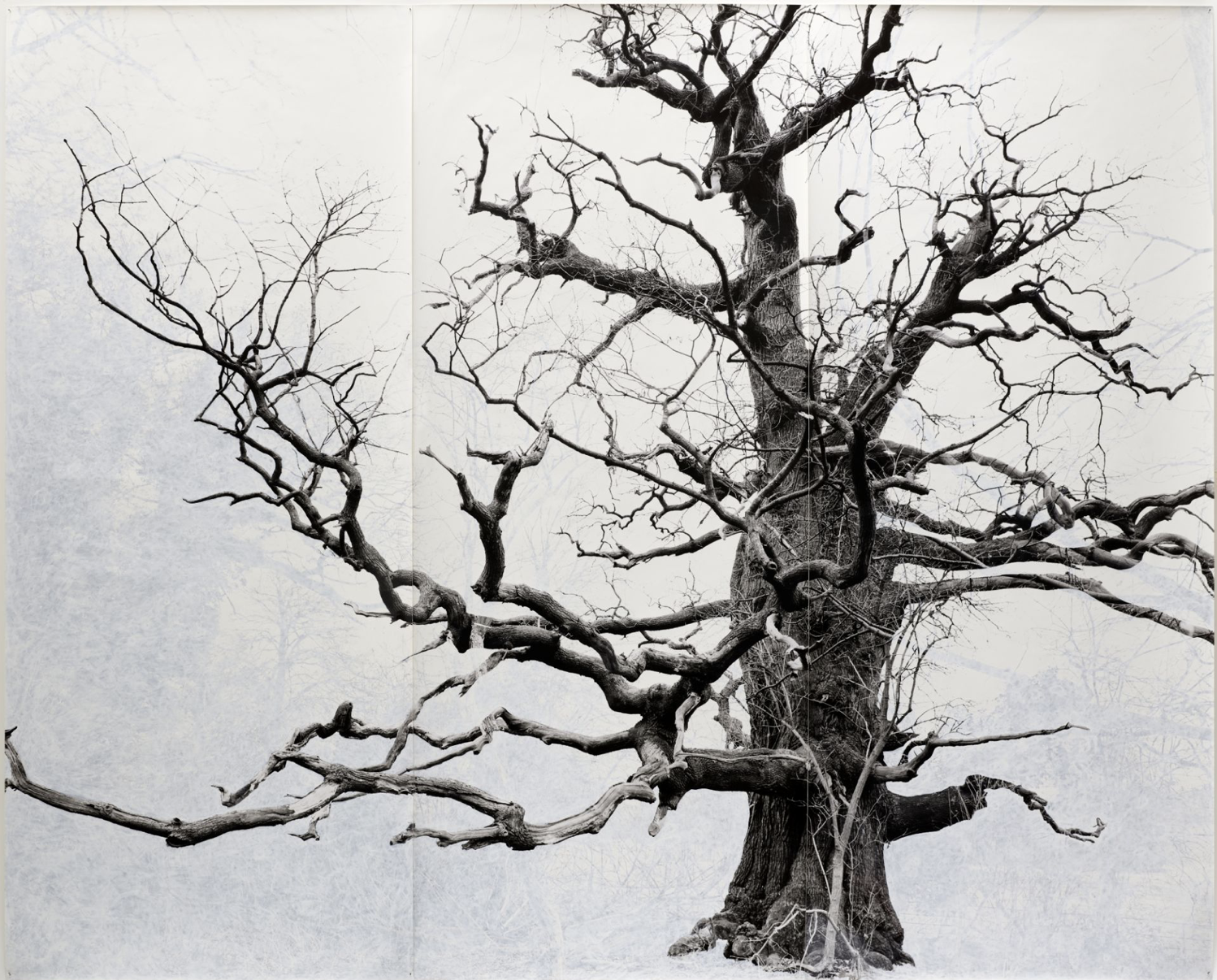
Artwork: Tacita Dean, Beauty, 2006, gouache on black and white fibre-based photograph mounted on paper
While Dean was in Houston, she engaged and created drawings inspired by works from the Menil’s Cy Twombly Gallery, which culminated in a small postcard titled “Found Cy, Houston, 2024,” a chance discovery that resonated with similar serendipitous encounters running through Dean’s work. The postcard was found in an antique shop in Houston’s Heights neighborhood, and bears a strong resemblance to Dean’s handwriting, creating a thread of connection between the artist, her subject, and the city of Houston. Also featured were Dean’s large-scale “portraits” of trees, where photographic prints of blossoming cherry trees, jacarandas, and ancient oaks are inscribed with hand-drawn marks in gouache and pencil. Dean’s deep connection with nature translates to her desire to capture the tree’s essence, and then extends to monumental chalk drawings on blackboards, depicting mountains, icebergs, and clouds. The large-scale chalk drawing The Montafon Letter (2017), features a mountain in the Austrian Alps, and was inspired by a letter recounting an avalanche in 1689 that killed 300 people. When a priest arrived to minister to the dead, another avalanche buried him, yet he was uncovered, miraculously, by a third avalanche. Through these works and the process, Dean explores the creation of geological and celestial formations that are precarious, seemingly at the edge of disappearance or erasure.
By focusing on Dean’s art making process and the role of chance, serendipity and inspiration, the exhibition highlights an aspect that is also crucial to her 16mm film work (I’ve been fortunate enough to have seen many of Dean’s films, and it’s this medium I’m most familiar with regarding her work): the role of analogue processes, time and human creativity. With AI and digital encroaching into so many art fields right now, it’s wonderful to be immersed in an artist’s world where simple mark making by a human hand can create such poetic and mesmerizing work, where according to Dean, “Drawing is the thread that connects everything.”