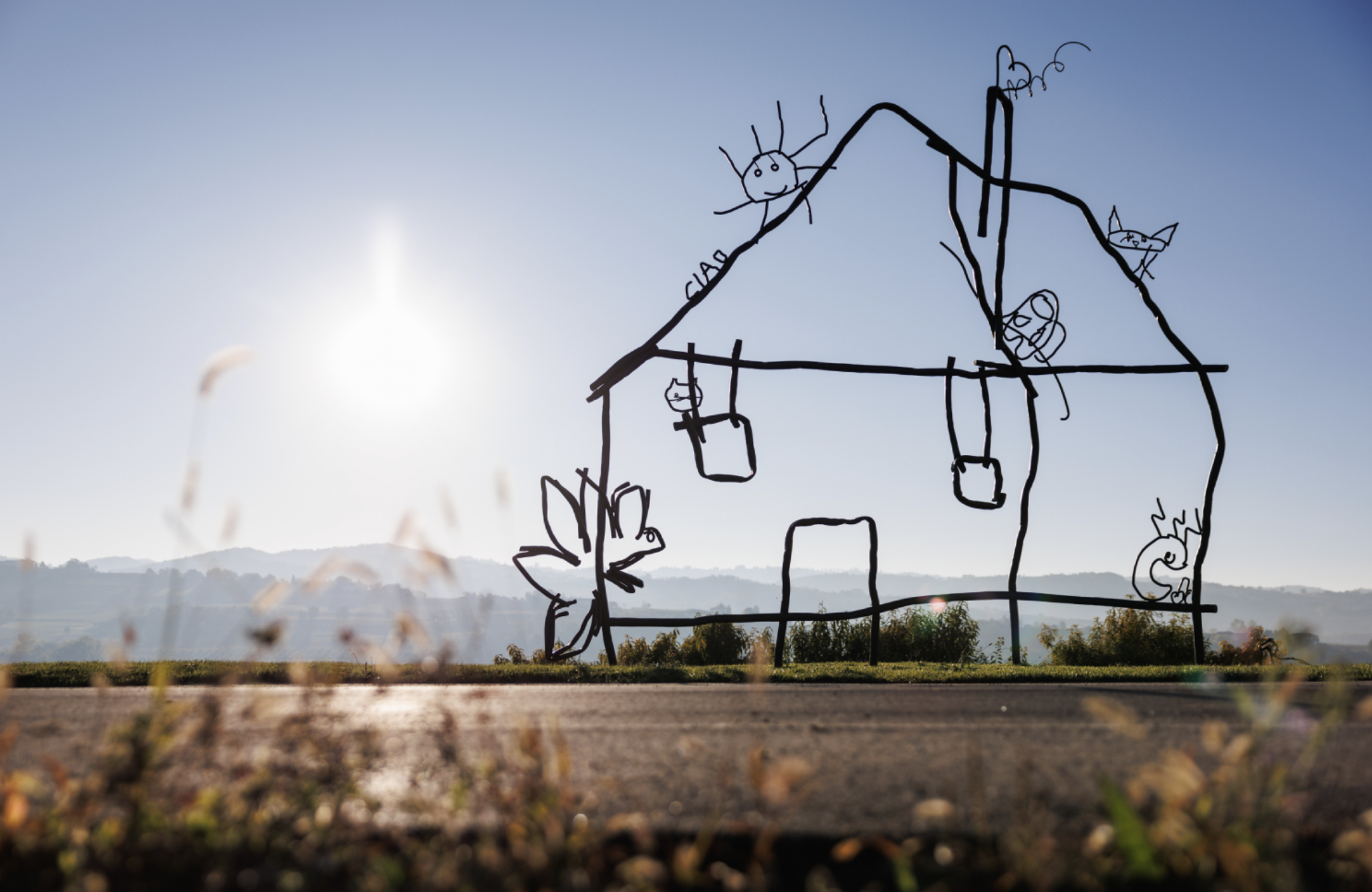
Artwork: Petrit Halilaj, Abetare (un giorno a scuola), Radis (seconda edizione), Dogliani, 2025
Petrit Halilaj’s public installation in Dogliani (Cuneo), Italy, commissioned by the Fondazione per l’Arte Moderna e Contemporanea CRT, is part of an ongoing series of works created since 2015 titled Abetare. The title for the Kosovar artist is significant as “abetare” is an alphabet primer for schools in Kosovo, and the inspiration for this work are the doodles on school desks Halilaj found in Dogliani and the Balkans. Drawing becomes sculpture through the bent, twisted steel tubes. This specific iteration is titled, Abetare (un giorno a scuola), where Halilaj creates an imaginary school house featuring the writing, creatures and symbols from the school desks. It is a fantastical work grounded in reality, but also a space of freedom, joy and play for children everywhere.
Halilaj is best known for his work delving into memory, displacement, war and childhood, having been a child refugee during the Kosovo/Serbian war, with his family home ruined and forced into a refugee camp in Albania. It was here in the camp that Halilaj met psychologist Giacomo “Angelo” Poli who was working for the UN and providing art materials for the children to express themselves. It was a pivotal experience shaping Halilaj’s future as an artist and the beginning of a lifelong friendship. Poli left the camp after two weeks but took many of Halilaj’s drawings with him, and Halilaj recounts: “Back in Italy he [Poli] showed my drawings, alongside those of other kids, and persuaded his municipality to give me a grant to go to the only art high school in Kosovo after the war. Eventually, Angelo and his wife hosted me for three years when I was at university [the Brera Academy in Milan]. They became my second family.”
Halilaj’s art often features materials from his homeland such as earth, wood, fabric and found objects, creating installations that reconstruct his childhood experiences of loss and survival and collective histories. Halilaj’s work transforms the trauma of conflict and violence into poetic reflections on heritage, identity, belonging, resilience and the pivotal role of human creativity.
I wrote an art story for Petrit Halilaj’s installation Dreaming on, fast asleep, your face came to my mind. When I opened my eyes, I was nowhere to be found, (2018) which you can read here.