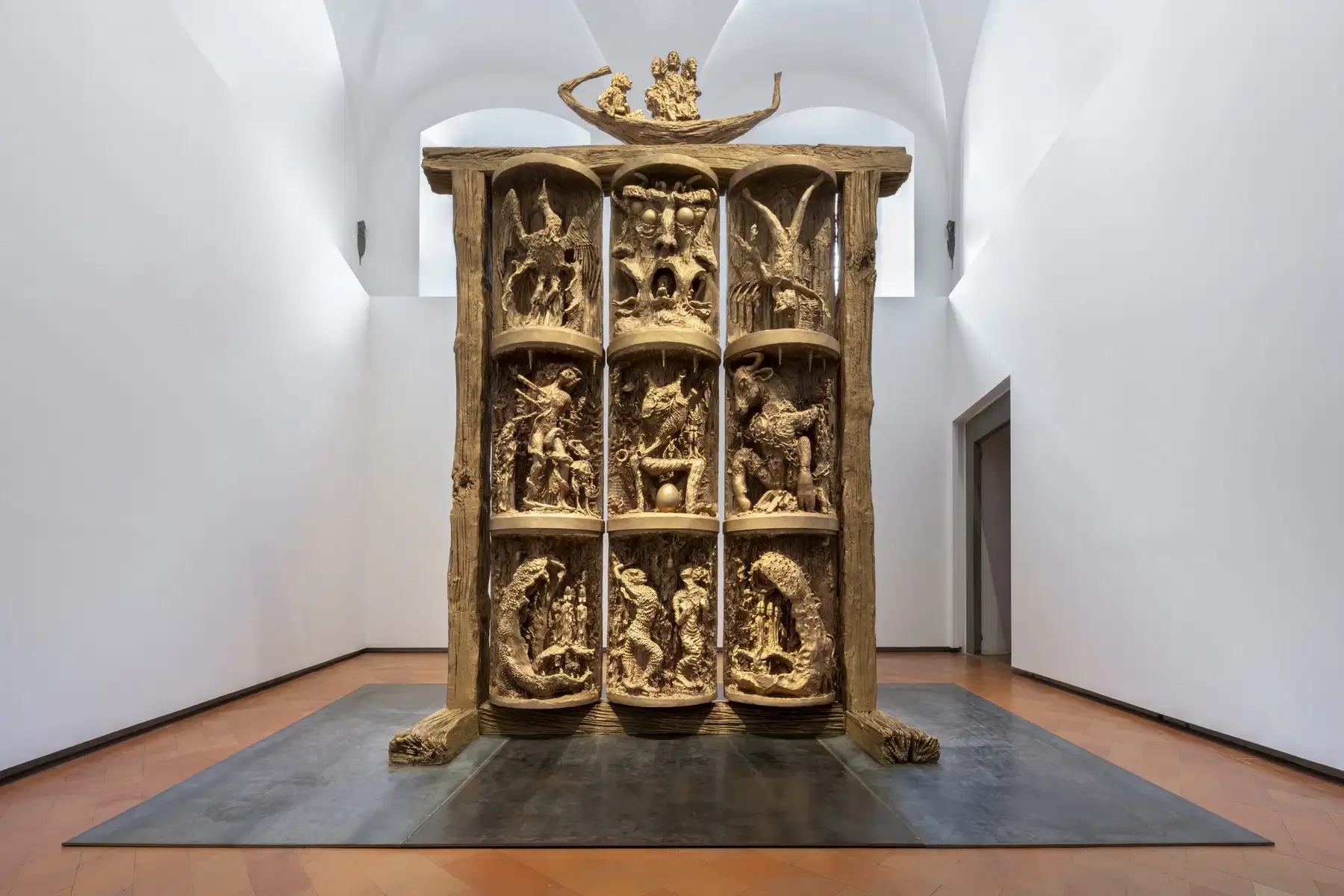
Artwork: Jean-Marie Appriou, Canto Infinito, Palazzo Strozzi, Florence, Italy, 2026
Canto Infinito (“infinite song”) is the title of French artist Jean-Marie Appriou’s current solo exhibition at the Palazzo Strozzi’s Project Space in Florence, Italy. Appriou’s sculptures and installations are built on hybrid figures where human, animal, plant and machines meld, inspired by mythology, literature, science fiction and how narratives are shaped through the passage of time from the ancient into the future. The material¾matter¾Appriou employs form a kind of alchemical process, where base clay, bronze, cast aluminium, steel, and hand-blown glass transform from terrestrial, to the celestial and even futuristic hybrid creations. At an elemental level, Appriou’s art is guided by the relationship between sculpture and literature, especially the junctures and transitions that occur when one story influences another over time, but also morphs into something new.
In Canto Infinito the obvious literary reference is Dante’s Divine Comedy, but also John Milton’s Paradise Lost, the work of William Blake, and a foundational ancient Egyptian text called The Book of Gates. The installation of sculptures culminates in the central artwork of the exhibition, a portal or gate featuring an array of creatures and symbolism illustrating heaven and hell. Appriou spoke about the exhibition and its inspiration: “I made this almost initiatory journey, much like so many artists before me since the Renaissance. Of course, there is Ghiberti’s Baptistery door, which Michelangelo famously called the Gates of Paradise. And then, centuries later, Rodin created his Gates of Hell. When Arturo Galansino invited me, I felt it was the right moment to speak about Florence—about my relationship with the city, but also with literature, especially Dante and the Divine Comedy, which later inspired extraordinary works by John Milton and William Blake. That is when I began thinking about creating a gate of my own. But I did not want it to belong solely to paradise or to hell. I wanted it to exist in a kind of third dimension. The rotating cylinders recall Japanese torii—spiritual gates that mark a passage. But here I wanted visitors to be able to compose their own relationship between paradise and hell.”
The rotating “doors” of the gate featuring imagery relating to paradise or hell, can be interacted with by the visitor, who is encouraged not to see these spiritual dimensions in terms of black and white, but as having no fixed border between them. Appriou alludes to this issue of interpretation, saying: “The angel’s hair, for example, is made from horns. The horns, the hair, even the eyes—they belong to the same material, the same nature. The horns represent the fallen angel, the devil, while the hair belongs to the angel himself. I wanted to suggest that Satan was originally an angel, and perhaps that an angel, too, might become Satan. It is an endless movement. We carry both good and evil within us. And this is always something that must be chosen.”
The exhibition is on at the Palazzo Strozzi until 23 August 2026.