Artwork: Stencil work by L.E.T. (@l.e.t._les.enfants.terrible), Stay Weird
Great stencil work from one of my favourite street artists L.E.T. (@l.e.t._les.enfants.terrible). Stay Weird.

Artwork: Stencil work by L.E.T. (@l.e.t._les.enfants.terrible), Stay Weird
Great stencil work from one of my favourite street artists L.E.T. (@l.e.t._les.enfants.terrible). Stay Weird.

Strange how a year ago I wrote a post about today being William Shakespeare’s birthday and 400 years since he passed away. I also happened to mention a wonderful film by Jim Jarmusch, Only Lovers Left Alive, because Jarmusch featured the character Christopher Marlowe played by John Hurt as the writer of Shakespeare’s plays. And he was a vampire!
Kind of full circle, I’ve just watched another Jarmusch film, Paterson. What’s marvellous is that it’s a film about a poet, so on Shakespeare’s birthday, I think it’s timely to mention it.
Quiet, nuanced and understated, the film is set in the New Jersey city of Paterson, and the poet played by Adam Driver has the same name as his hometown, and goes about his days, earning a living as a bus driver, but writing poems whenever he can. The city was also home to one of Paterson’s favourite poets, William Carlos Williams, and where Allen Ginsburg was born. Such intertwined connections run throughout the film, which follows the arc of the days of the week, and at its heart, is a meditation on creativity, process, how the mundane can inspire, how small acts weave a wondrous tapestry of a life deeply felt, observed and interpreted. And the importance of love, reflected most in the relationship between Paterson and his wife played by Golshifteh Farahani. The support, understanding, tenderness and passion between the two beautifully underpinned the story. And when a pivotal act causes Paterson to question his ambition, serendipity and destiny comes into play.
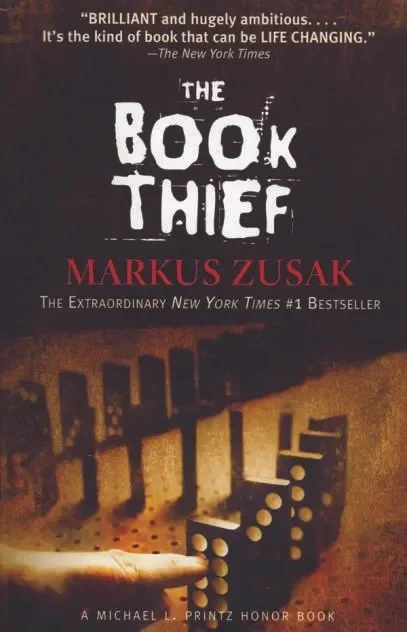
Rereading a book after a time-lapse is like diving into a familiar yet irrevocably altered world.
I'm rereading Markus Zusak's The Book Thief. Despite winning the Printz Award for excellence in YA literature, I don't relate to Zusak's book as young adult. It's a cross-over, one of these layered, generous, enlightening stories set in World War II, and while I'm not going to debate the whole pigeon-holing of how books are marketed, this is the kind of book I love, because it defies a narrow categorisation based on a potential audience.
Back to the book—the first time I read it I was hesitant about the voice of Death. It was a jarring note in the story: reaping souls between this world and the next, disconnected yet participatory, observing with an altered perception of sensation; it felt a little contrived despite the malleable inventiveness of Zusak's language. Happily, this time round, it hooked me in from the start. And what a great start! From the Prologue:
“It's just a small story really, about amongst other things:
a girl
some words
an accordionist
some fanatical Germans
a Jewish fist-fighter
and quite a lot of thievery
I saw the book thief three times.”
A love of words and books, the precariousness of life, the treachery of death, the ethical dilemmas and threat of living under fascism, fighting for what you love and learning to see through difference to appreciate our shared humanity—this and much more could be added to the list above. Not quite a “small” story.

Artwork: mural by Sean Yoko, Owena, 2017
A new mural using glowing paint that comes “alive” at night from Sean Yoro aka Hula, Owena (land): “The world is full of magic things, patiently waiting for our senses to grow sharper"—W.B. Yeats.
From the crew at Backwash and Finisterre, a short film that has a singular vibe—just go for it.
Here's a re-enactmant of artist James Lee Byars's performance, The Perfect Love Letter I Write I Love You Backwards In The Air. First performed by Byars in various locations in 1974, this performance was sponsored by Peter Lund Gallery and Nasjonalmuseet in 2016.

Image: Henry Rollins, Photograph by Richard Bellia
Who would have thought? Henry Rollins, the poet:
"Be like the moon... The moon has been around a long time and has never tried to rip anyone off. The moon does not care who you want to touch or what color you are. The moon treats everyone the same... Be like the moon. When others insult or belittle in an attempt to elevate themselves, the moon sits passively and watches, never lowering itself to anything that weak. The moon is beautiful and bright... The moon never shoves clouds out of its way so it can be seen. The moon needs not fame or money to be powerful. The moon never asks you to go to war to defend it. Be like the moon." (@_nitch)

Great quote from Patti Smith encapsulating the beginning of an incredible career: "No one expected me. Everything awaited me."
Just discovered this—a short documentary, A Million Waves, about 19 year-old Kadiatu Kamara, KK, the only female surfer from Sierra Leone and the crucial role surfing has in her life. Quietly powerful, it is life affirming, hopeful, exploring how surfing has given her a way to cope with personal tragedy, and a sense of who she is, who she wants to be.
The documentary was created by Daniel Ali and Louis Leeson.
Recently I was reading Neil Gaiman's journal to check out his New Year's message and found this, an incredibly moving version of Leonard Cohen's song, Democracy. Neil recorded the lyrics, Amanda Palmer featured on the piano, the paintings were created by David Mack and given life through the animation of Olga Nunes. Given the political climate in the US and the passing of Leonard, it's timely. Neil and Amanda gave the video to PEN America in support of PEN's continued mission to defend free expression.

Artwork: Wall mural by SETH, Italy
dreams
as new-grown leaves
shoots spindling
from my eyes
of you
yet to be known
still unseen
© Angela Jooste
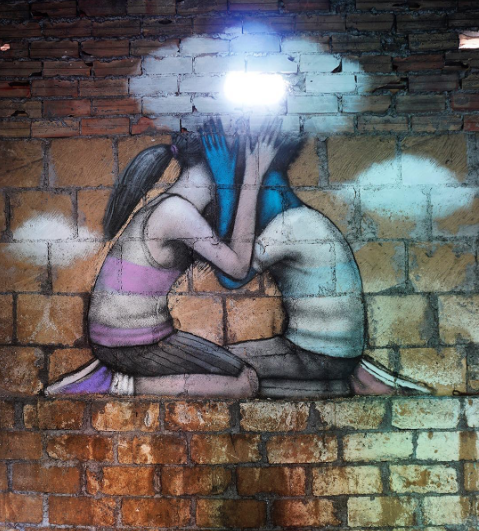
Artwork: SETH, Love Conquers All (Omnia vincit amor)
And to end the year—a beautiful image from the artist, SETH (@seth_globepainter, Julien Malland, www.seth.fr), a work he's titled Love Conquers All (Omnia vincit amor). The best way to bring in the New Year.

Artwork: Photograph by Woody Gooch (@woodygphoto)
I love great surf photography, and probably one of my favourite photographers is Woody Gooch. He has a wonderful sense of scale, with a great appreciation of how the natural world can overwhelm with its power and beauty. Check out his work at www.woodygooch.com or on IG (@woodygphoto).

Photograph: Mick Fanning surfing under Northern Lights, 2016
Spectacular. Mick Fanning's recent adventure—a midnight surf under the Northern Lights.

Just saw the film, Arrival. It was eerily strange which was great for a Hollywood film. That sense of such an unknown entity coming to Earth and humans having to rise to the challenge of communicating with it—to learn about it and its purpose—had my mind whirling with thoughts about language.
Spoilers here.
When the linguist in the film, Louise, cracks the “code” so to speak of what the “aliens” were saying, she had to ask them the “big” question: why were they here? The answer she deciphered was “weapon” or possibly “tool”. Obviously that sent everyone into a panic, with retaliation or obliteration on the military’s mind. But what Louise finally figures out is their purpose wasn’t to proliferate a weapon but to impart a “gift”—language. They were here to give their language so that humans could help them in the distant future.
Language is a gift. As a means to communicate, connect, understand, empathise and help. To make sense of our existence and express what it means to be human. It’s amazing how we take this gift for granted, simply in that we use it every day. Affirming the idea in the life-giving capacity of language, Toni Morrison in her Nobel Lecture in 1993 spoke of language’s vitality, how “It arcs toward the place where meaning may lie.”
Her discussion of language is couched in a parable, and her words are those of a wise, blind woman having to communicate with her much younger visitors. The challenge is communicating that which seems inexplicable, and how language meets that challenge. Why language matters.
“Word-work is sublime, she thinks, because it is generative; it makes meaning that secures our difference, our human difference – the way in which we are like no other life.
We die. That may be the meaning of life. But we do language. That may be the measure of our lives.”

Listening to Gilligan Moss' remix of Glass Animals' song Gooey on repeat. Makes me smile. Check it out!

'THIS IS THE WALL WE NEED'
Words written on a Post-It note and stuck on a 14th street subway wall in New York. The art installation was created by artist, Levee, so that people could put their thoughts on Post-it notes, mostly in response to the 2016 election.

Nara channeling Antoine de Saint-Exupery's Little Prince vibes. Finding home.

Forget the hype. That’s what I keep reminding myself when listening to Frank Ocean’s new album. Both the video-album, Endless and the album, Blonde.
In the end, it’s the music that matters. With the drop of Blonde there’s been fudged release dates; a video-album that could have been the actual album; the exclusive Apple music deal; huge number of stellar collaborators, pop-up shop promos and a glossy mag accompanying the album.

Too much hype. So, I decided to just focus on the music. Watching Endless was intriguing, seeing Frank going DIY and building his spiral staircase (more sculpture than functional), but I found myself closing my eyes and just listening. Whether the video was a metaphor for crafting, creating, taking time, the ongoing process of making stuff—whatever. In the end, the music felt like submerging myself in a sonic sea. I just drifted along with the current. It’s an immersive experience, like listening to Blonde, and it’s beautiful. Blonde has a different tone, edgier, darker, but equally poetic, with that quality of slipstreaming from one song to the next. Both are mesmerising and it’s been wonderful engaging with Frank’s words and voice once again.
I’ll be listening to both for a long time, because the wait has been worth it.

"Many years later, as he faced the firing squad, Colonel Aureliano Buendia was to remember that distant afternoon when his father took him to discover ice."
So begins Gabriel Garcia Marquez's marvellous tale, One Hundred Years of Solitude. Marquez's book wasn't my introduction to South American magical realism, that book was Isabel Allende's The House of the Spirits. Thoroughly entranced, I went searching for more and discovered Marquez.
In a Paris Review interview (The Art of Fiction no69) I was delighted to read how Marquez found the tone for One Hundred Years of Solitude. This is what he had to say:
GARCÍA MÁRQUEZ
[] It was based on the way my grandmother used to tell her stories. She told things that sounded supernatural and fantastic, but she told them with complete naturalness. When I finally discovered the tone I had to use, I sat down for eighteen months and worked every day.
INTERVIEWER
How did she express the “fantastic” so naturally?
GARCÍA MÁRQUEZ
What was most important was the expression she had on her face. She did not change her expression at all when telling her stories, and everyone was surprised. In previous attempts to write One Hundred Years of Solitude, I tried to tell the story without believing in it. I discovered that what I had to do was believe in them myself and write them with the same expression with which my grandmother told them: with a brick face.