DO

Image: From the Lewitt Collection via www.brainpickings.org

Image: From the Lewitt Collection via www.brainpickings.org

Seems that American artist, Sol Lewitt, was way ahead of Nike and their slogan “Just do it”. In this fabulous letter written in 1965 to artist, Eva Hesse, who was obviously going through tremendous doubt about her work, and possibly life, he tells her to cut through the crap and “DO”!

Here's an excerpt:

“Try and tickle something inside you, your ‘weird humor.’ You belong in the most secret part of you. Don’t worry about cool, make your own uncool. Make your own, your own world. If you fear, make it work for you—draw & paint your fear & anxiety. And stop worrying about big, deep things such as ‘to decide on a purpose and way of life, a consistant [sic] approach to even some impossible end or even an imagined end.’ You must practice being stupid, dumb, unthinking, empty. Then you will be able to

DO

I have much confidence in you and even though you are tormenting yourself, the work you do is very good. Try to do some BAD work—the worst you can think of and see what happens but mainly relax and let everything go to hell—you are not responsible for the world—you are only responsible for your work—so DO IT. And don’t think that your work has to conform to any preconceived form, idea or flavor. It can be anything you want it to be. But if life would be easier for you if you stopped working—then stop. Don’t punish yourself. However, I think that it is so deeply engrained in you that it would be easier to

DO”

what matters

IMG_E1673.jpg

Every day I'm reminded of what matters. I wear my Lise Vanrycke “Love” bracelet 24/7. It's a bit battered, but it's always there on my wrist so I never forget what's important.

The cuff I also wear most days, and for ages I thought the matrixy-glyphs were just a pattern until my friend, Hanna, pointed out they were Chinese characters! She made out “truth”, “love” and “know”, and I was so intrigued, I contacted the jeweller, Camilla Gough, and asked for the full text. She replied that she'd lifted the text from a Chinese newspaper and was simply relieved to know she hadn't inscribed the recipe for two-minute noodles on my bracelet!

little fang

s-l1000.jpg

Occasionally great oddball stuff crops up on IG, like French band, Dionysos' album cover, Vampire En Pyjama. I went in search of the album and sadly, the music did nothing for me, but the visual of a lone vamp brooding in his abode and wearing his jammies definitely made up for it.

But it did bring to mind a song by Avey Tare's Slasher Flicks—Little Fang. This wonderfully wonky song is about the journeys of a cat vampire called, Little Fang. It’s kind of nuts (the video is bonkers). Enjoy!

Little Fang
Avey Tare's Slasher Flicks


unexpected

Artwork: by @phlegm_art

Artwork: by @phlegm_art

So, I was walking down Chapel Street the other day (probably one of my least favourite streets in Melbourne), and halfway between the fashionista and the grunge end, I happened to look up and saw this: a pretty remarkable artwork by @phlegm_art.

grow new thoughts

Screen Shot 2018-02-01 at 9.35.45 AM.png

Artist Sean Yoro's—aka the hula (@the_hula)—new mural was created in a burnt forest in the US that had recently been devastated by wildfires. He was inspired by, “the need to grow new thoughts on preserving and protecting our lands.”

le guin

ursula-k.-le-guin.jpg

It's Virginia Woolf's birthday today and Ursula Le Guin recently passed away. Such literary greats. Just last week I was thinking about re-reading Le Guin's novel, Lavinia. A retelling of Virgil's Aeneid from the perspective of Lavinia, the daughter of King Latinus and Queen Amata, and the future bride of Turnus, who never once speaks in the original tale, but in Le Guin's book, is given her own voice.

Here's Le Guin's view on being called a “science fiction” writer, and about the genre in general:

“I don't think science fiction is a very good name for it, but it's the name that we've got. It is different from other kinds of writing, I suppose, so it deserves a name of its own. But where I can get prickly and combative is if I'm just called a sci-fi writer. I'm not. I'm a novelist and poet. Don't shove me into your damn pigeonhole, where I don't fit, because I'm all over. My tentacles are coming out of the pigeonhole in all directions.”

(The Paris Review, 'Art of Fiction no. 221')

angel

51cp6TBAcWL._SX425_.jpg

Angel is one of my favourite tracks from Massive Attack's brilliant album, Mezzanine. Disquieting, shadowy and beautiful. Check it out.

Angel
Massive Attack


channel orange

The alternative 'nostalgia' cover art

Image: The alternative 'nostalgia' cover art for Frank Ocean’s Channel Orange

It's HOT. If I go outside I pretty much melt into a puddle. So, I've been holed up under the AC to work, while occasionally listening to one of my all-time favourite albums, Frank Ocean's Channel Orange. It continues to enthral—that voice!—with his compelling lyrical storytelling.

Ocean once said : “[Storytelling’s] the more interesting part about making music for me, or making albums and songs and stuff. So much so that I might not make another album. I might just write a novel next.”

He made that comment before the drop of his albums Blonde and Endless. I love the idea of him writing a novel and hopefully, more music. Here's a small taste: Sweet Life

Sweet Life
Frank Ocean


new moon

Image: photograph by @isaacexplores & featured on @universetoday

Image: photograph by @isaacexplores & featured on @universetoday

New moon today. Contemplating the cosmic, some wise words from Carl Sagan: “For small creatures such as we the vastness is bearable only through love”'

curiosity feeds imagination

Artwork: wall mural, Curiosity Feeds Imagination by @mantrarea, 2016

Artwork: wall mural, Curiosity Feeds Imagination by @mantrarea, 2016

For book lovers, readers and dreamers, here’s this amazing wall titled, Curiosity Feeds Imagination by Mantra (@mantrarea), created for the Kufa Urban Art, Esch festival in 2016.

red thread

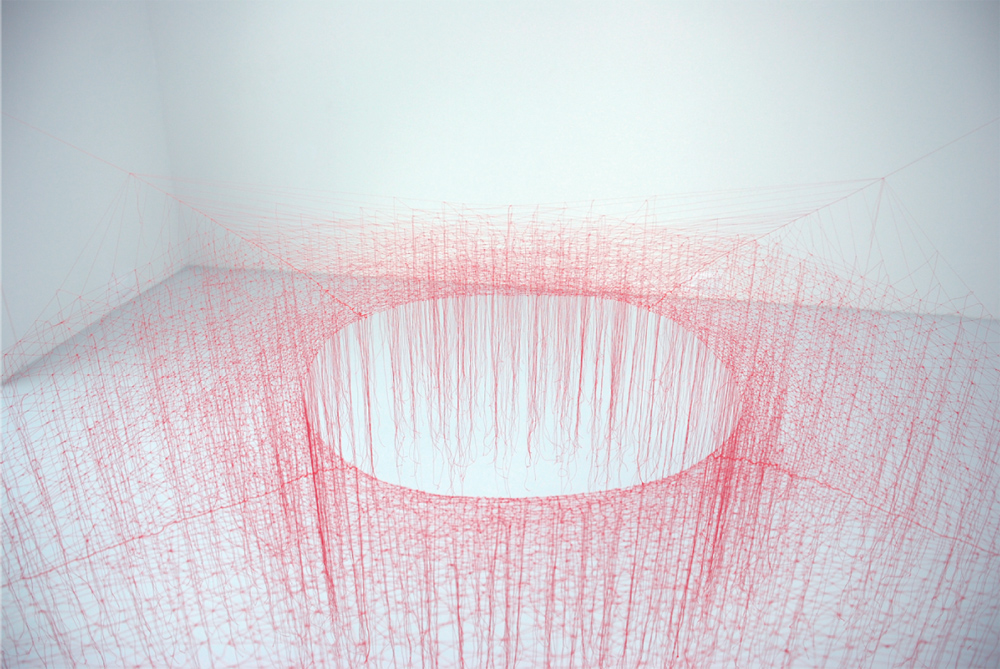
Artwork: Akiko Ikeuchi, Knotted Thread, 2011

Artwork: Akiko Ikeuchi, Knotted Thread, 2011

Red: primary and primal.

The colour of blood; what’s basic to life. It’s a colour associated with passion, love, anger and pain. It’s chromatically intense and draws the eye whether you see it in nature or on the street.

Discovering the work of Japanese artist, Akiko Ikeuchi, what jumped out at me was her use of red thread. Some of her sculptural installations feature white or black thread, but it’s her red thread pieces that drew me in. 

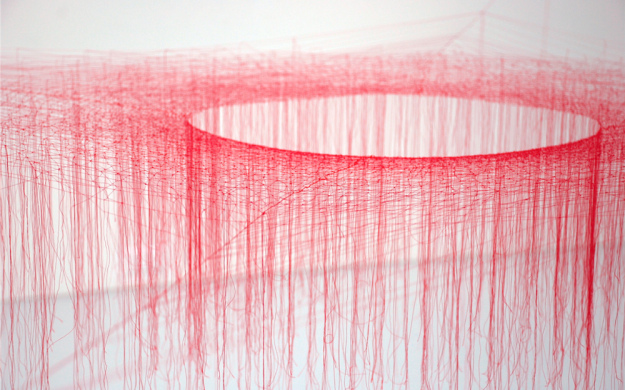
Artwork: detail of Akiko Ikeuchi, Knotted Thread, 2011

Artwork: detail of Akiko Ikeuchi, Knotted Thread, 2011

Using delicate silk thread, Ikeuchi meticulously plans her thread sculptures using 3-D modelling and knots them by hand. The construction is then anchored in space and oriented by geomagnetism: north, south, east and west. These webs have associations with natural phenomenon: whirlpools, hurricanes and galaxies. With the energies of life. Ikeuchi’s creations limn what is seen and unseen; what is tangible and intangible. The viewer engages with the piece through their very movements: the threads vibrate with the air, the changes of humidity, by breath. 

Artwork: detail of Akiko Ikeuchi, Knotted Thread, 2011

Artwork: detail of Akiko Ikeuchi, Knotted Thread, 2011

In Ikeuchi’s words: “I am continuously trying to mediate something invisible, not easily visible in this world, which is mostly fragile.”

As for the colour red, what I found fascinating is the similarity with two other Asian artists I’ve written about in ‘Art Stories’, both featuring red thread in their art. 

For Chiharu Shiota, the red thread is a symbol of connection, the “ocean of life”: “It’s like a red ocean you can see from the top. When people look in the space, they immediately can see the universe.” Specifically relating to her installation for the Japanese Pavilion at the Venice Biennale, The Key in the Hand (2015), the threads signify the connection of humans throughout the world by red threads.

This is similar to Beili Lu’s Lure/Wave (2010) installation, except she’s referring to a specific Chinese folk legend, The Red Thread of Fate. It tells of how when children are born, invisible red threads connect them to their soul mates. Over the years, their lives become closer until they eventually find each other, overcoming social and physical divides that might otherwise separate them. This magical cord might stretch and tangle, but will never break. There's a comparable Japanese folk legend, but it extends to all relationships, whether friendships, family, or couples.

I’ve yet to unravel the significance of the red thread for Ikeuchi, but I have a feeling it stems from the life force of the energies she works with to create her exquisite art. 

the shape of water

the-shape-of-water-poster-405x600.jpg

Guillermo del Toro’s film, The Shape of Water is magic.

Part fairytale, part myth, the story of Eliza Esposito—the princess without a voice—a janitor at a government facility, and the amphibious creature from South America she falls in love with, has a quirky humour and aesthetic that reminded me of the films of Jean-Pierre Jeunet (Amelie, The City of Lost Children, A Very Long Engagement), laced with a dark and haunting lyricism. It’s a film that doesn’t shy away from issues of loneliness, isolation, discrimination, politics, race, and the violence and ugliness perpetrated on people (and creatures) deemed different. And what it means to be human; to be truly seen.

While I don’t want to ruin this film for anyone who hasn’t seen it, it’s the poem recited at the end that encapsulates the heart of this gorgeous tale of love, longing and transformation: 

Unable to perceive the shape of you

I find You all around me.

Your presence fills my eyes with

Your love. It humbles my heart,

For You are everywhere…

Morley's underwater adventures

Screen Shot 2018-01-03 at 5.48.59 PM.png

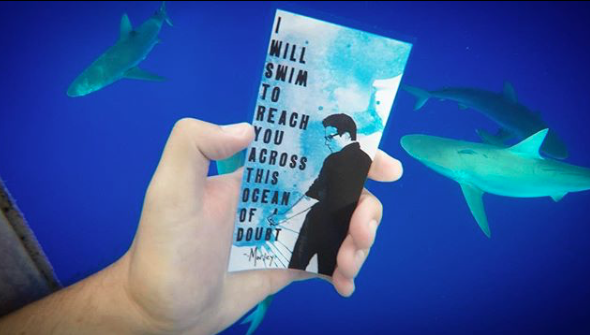
This is great. Artist Morley (@official_morley) took his street art to another level—underwater!

On a trip to Hawaii, he and his wife decided to have an ocean adventure. They got in a cage underwater to check out some swarming sharks. While there, he stuck his hand outside the cage with one of his laminated artworks and took a photo.

And this is what he had to say about it:

“The message speaks to how doubt can feel insurmountable. It can feel like a chasm filled with ever searching creatures looking only to consume your hope, your faith and your optimism. Some people- and some dreams- are worth the journey, no matter how perilous they prove to be”'

a new year

Artwork: C215 (Christian Guemy) L’amour triomphe de tout

Artwork: C215 (Christian Guemy) L’amour triomphe de tout

Here's to love, peace, kindness, hope, grace, empathy; being brave, honest, thoughtful, giving—to being whoever you want to be; whoever you believe you were meant to be. And don't forget your sense of humour! Laughter was a big antidote to some of the craziness that was 2017.

infinitesimal being

Photo: @mattbroadwin

Photo: @mattbroadwin

I seem to be binge-reading Pablo Neruda's poetry these days. So, I just had to share this from Neruda's Selected Poems, a poem plainly titled Poetry (La poesía), exploring Neruda's revelation about being a poet, about wanting to write poetry, the tentative first lines, and how it made him feel. The third stanza is stunning:

And I, infinitesimal being,

drunk with the great starry

void,

likeness, image of

mystery,

felt myself a pure part

of the abyss,

I wheeled with the stars,

my heart broke loose on the wind. 

so lightly here

Artwork: paste-up by @murmurestreet

Artwork: paste-up by @murmurestreet

Something of the Christmas spirit—here are some beautiful words from Leonard Cohen: “We are so lightly here. It is in love we are made. It is in love we disappear.”  

(@_nitch)

eL Seed: The Bridge

For eL Seed’s artwork in the demilitarized zone between North and South Korea, he initially wanted to create a bridge-like sculpture rising about 20 metres, based on the idea of unity, peace and mutual respect. But due to security issues, this couldn’t be realized, so the result is this laser-cut horizontal artwork at the fence of the DMZ.

Describing the project, eL Seed wrote: 

“Bridges are never built from one side. It involves taking a step forward from both sides. I proposed a bridge that would begin in South Korea and extend to the mid-point a gesture of solidarity. The project will remain unfinished until another art piece is installed in North Korea, thus making it the ultimate symbol of unification. 'The Bridge' feeds the memories of the older generations with the souvenir of one united country, it stands as a reminder for the younger generations that there is a shared culture, language, and traditions and that art can bring people, culture and generations together beyond political conflict.”

The artwork translates the words of a poem, via eL Seed's  “calligraffiti”, by Kim Sowol, a North Korean poet who passed away before the country was divided:

You may remember, unable to forget:
yet live a lifetime, remember or forget, 
For you will have a day when you will come to forget.

You may remember, unable to forget:
Let your years flow by, remember or forget, 
For once in a while, you will forget.

On the other hand it may be:
How could you forget
What you can never forget? 

Artwork: eL Seed, The Bridge, 2017 (photo: @t.jchoe)

Artwork: eL Seed, The Bridge, 2017 (photo: @t.jchoe)

sky of beijing

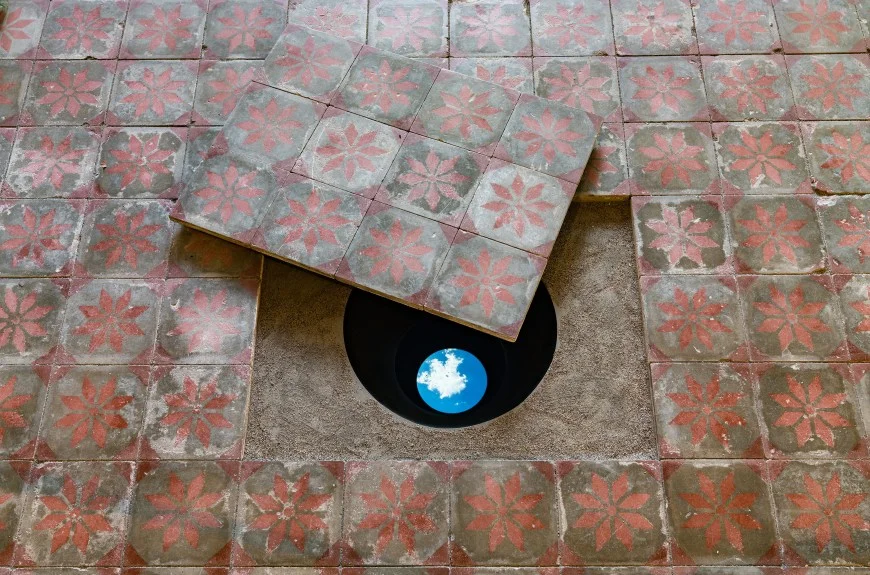
Artqoek: Wang Gongxin, The Sky of Beijing, 2017 Guggenheim, New York

Artqoek: Wang Gongxin, The Sky of Beijing, 2017 Guggenheim, New York

I recently came across this video installation by Chinese artist, Wang Gongxin. It’s showing at the Guggenheim NY: Sky of Beijing—Digging a Hole in New York, 2017. 

The genesis of this piece was a mirror installation created by Gongxin in 1995. After living in New York for nearly 12 years, Gongxin returned to China and created a video installation in the floor of his courtyard house. He dug a hole, 3 meters deep, and placed a video monitor at the bottom. It showed the sky in Brooklyn and was aptly named, The Sky of Brooklyn. There was also sound featured, a brief dialogue: “What are you looking at?” and then, “It’s nothing. Just the sky.”

Both pieces play on the idea of the remote distance between the two countries; the expression “digging a hole to China”, as the only direct (and impossible) way to get there, and the disparate cultures Gongxin experienced and its impact on identity. Yet, it’s also an eloquent meditation that despite borders, distance and differences, we all live under the same sky.